Allen-Bradley
RFQ Ready
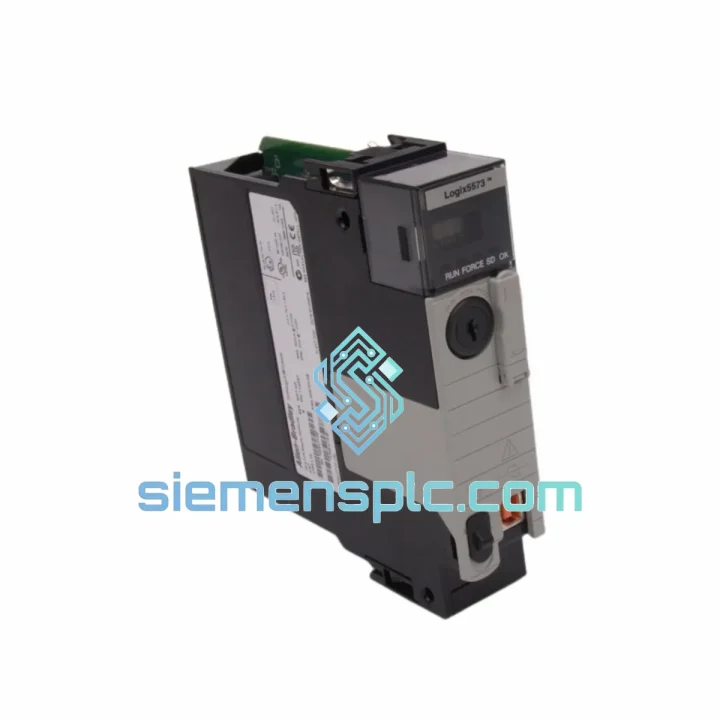
Allen-Bradley 1756-L71 PLC Controller – ControlLogix 1756 Series
ControlLogix
Origin US
PLC Controller
Request verified availability, condition, replacement risk review, packing options and courier lead time for 1756-L73.
Click Request Quote and the part number is inserted into the inquiry form automatically.
Core fields for model confirmation and RFQ routing. Detailed product narrative remains below.
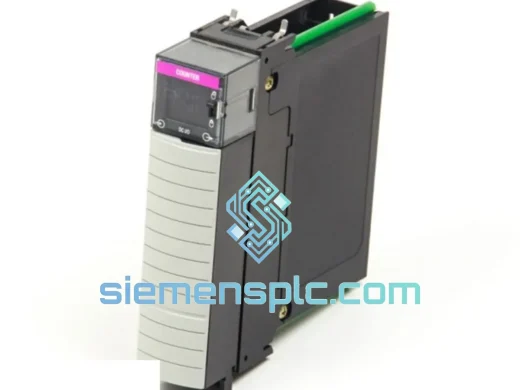
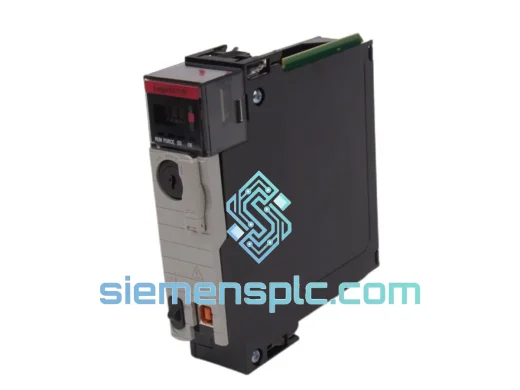
The 1756-L73 is the Logix5573 processor within Rockwell Automation’s ControlLogix 1756 platform — a single-slot CPU module that functions as the sole arbitration authority over the 1756 chassis backplane. Every scan cycle, the processor negotiates I/O data ownership across all installed modules via the ControlBus backplane, executing tag-based logic at deterministic intervals while simultaneously managing CIP messaging queues for networked devices. At 8 MB of user memory, the L73 occupies the mid-upper tier of the Logix5573 family, positioned between the 4 MB L72 and the 16 MB L74 — a deliberate engineering choice for applications where program complexity, tag database depth, and motion axis count collectively exceed what the L72 can sustain without memory fragmentation risk.
In practice, the 1756-L73 is deployed wherever a control system must simultaneously manage discrete I/O, analog process loops, coordinated multi-axis CIP Motion, and peer-to-peer EtherNet/IP messaging — all within a single execution context. Automotive body-in-white lines, continuous chemical batch reactors, offshore compressor station panels, and semiconductor wafer-handling cells represent the core application envelope. The processor’s architecture is not designed for simplicity; it is designed for determinism under load, and the 8 MB memory ceiling gives program engineers the headroom to implement full Add-On Instruction (AOI) libraries, extensive UDT structures, and historical data buffering without compromising scan time integrity.
Real-time Stock & RFQ: [email protected] | WhatsApp: +86 18359268345
| Parameter | Specification |
|---|---|
| Catalog Number | 1756-L73 |
| Processor Family | Logix5573 (ControlLogix) |
| User Memory | 8 MB |
| I/O Capacity | Up to 128,000 I/O points |
| Tasks Supported | 32 tasks (1 continuous + 31 periodic/event) |
| Programs per Task | 100 |
| Backplane Interface | ControlBus (1756 chassis proprietary) |
| Programming Port | USB Type-B (local programming only) |
| Network Connectivity | Via 1756-EN2T / 1756-EN3TR (EtherNet/IP); 1756-CN2R (ControlNet) |
| Motion Axes | Up to 100 coordinated CIP Motion axes (firmware-dependent) |
| Energy Storage | 1756-ESMNSE (capacitor-based, no battery required) |
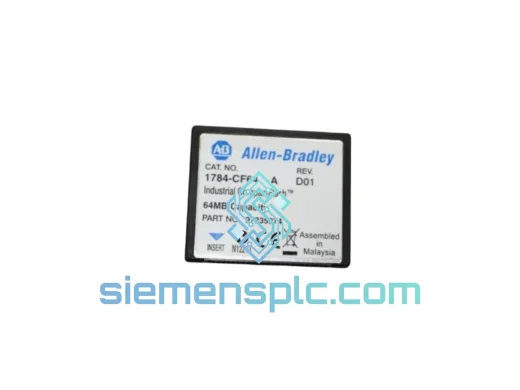
| Non-Volatile Storage | 1784-CF128 CompactFlash card (optional) |
| Operating Temperature | 0 °C to 60 °C |
| Storage Temperature | -40 °C to 85 °C |
| Relative Humidity | 5% to 95% non-condensing |
| Chassis Compatibility | 1756-A4, A7, A10, A13, A17 (all revisions) |
| Slot Occupancy | Single slot |
| Certifications | UL, CE, cUL, ATEX Zone 2 (with appropriate enclosure) |
| Firmware Upgrade | Field-upgradeable via ControlFLASH utility |
| Warranty | 12 months functional warranty from siemensplc.com |
| Lead Time | In-stock units: 1–3 business days dispatch. Non-stock: 5–15 business days subject to sourcing confirmation. |
Backplane Arbitration and Scan Cycle Architecture
The 1756-L73 does not share backplane arbitration with any other module. It holds exclusive ownership of the ControlBus token during each I/O scan phase, sequentially polling each installed module’s input image table and writing output image data in a deterministic sequence. The backplane operates at a fixed internal clock rate, and the processor’s task scheduler enforces periodic task execution with jitter tolerances typically below 1 ms for properly configured systems. This architecture eliminates the bus contention issues common in older rack-based PLCs where multiple masters competed for backplane access.
Memory Architecture and Tag Database Management
The 8 MB user memory space in the L73 is managed as a unified flat address space, with the Logix5573 firmware allocating memory dynamically across program code, tag data, I/O image tables, and message buffers. Unlike older fixed-memory PLC architectures, the L73 does not partition memory into separate code and data regions at the hardware level — the firmware memory manager handles allocation at runtime. This means a program with a large UDT-heavy tag database but compact ladder logic will consume memory differently than a program with extensive AOI nesting and minimal tag structures. Engineers migrating from L72 to L73 typically do so when tag database growth — particularly from historian buffering or large array structures — begins to approach the 3.5–3.8 MB practical ceiling of the L72’s usable space.
EMC Design and Isolation
The 1756-L73 is housed in a die-cast aluminum module shell that provides mechanical shielding against radiated EMI. The backplane connector interface uses differential signaling on critical data lines, reducing susceptibility to common-mode noise induced by adjacent high-current I/O modules or drive feedback wiring routed near the chassis. The processor’s internal power regulation circuitry is isolated from the backplane 5 VDC rail by a DC-DC converter stage, preventing conducted noise from power supply switching transients from reaching the processor core logic. For installations in high-EMI environments — such as near variable frequency drives or resistance welding equipment — Rockwell’s published installation guidelines specify chassis grounding strap requirements and cable routing separation distances that, when followed, maintain the module’s CE-certified EMC performance envelope.
Redundancy Arbitration Logic
When paired with the 1756-RM2/A redundancy module in a dual-chassis configuration, the L73 participates in a continuous crossload protocol that synchronizes the primary and secondary processor tag databases across the redundancy link at the end of each scan cycle. The RM2/A module monitors heartbeat signals from both processors and initiates a switchover when the primary fails to assert its heartbeat within the configured timeout window — typically resulting in a bumpless transfer completed within one scan cycle of the secondary processor. The L73’s firmware includes dedicated redundancy state machine logic that manages the primary/secondary role negotiation during startup and after switchover events, ensuring that the secondary does not assert control until its tag database is confirmed synchronized.
Every 1756-L73 unit dispatched from siemensplc.com undergoes a structured pre-shipment verification protocol. Visual inspection covers housing integrity, backplane connector pin condition, label authenticity markers, and firmware revision label consistency. Each unit is seated in a 1756 chassis, powered, and confirmed to reach RUN-mode status before packaging. Firmware revision is documented and provided with the shipment record. Units are packaged in anti-static ESD bags with foam cushioning inside double-wall export cartons rated for international air freight handling.
Our sourcing operation is based in Xiamen, China — a designated free-trade port city with direct air cargo connections to major logistics hubs including Hong Kong, Singapore, Dubai, Frankfurt, and Los Angeles. Xiamen Gaoqi International Airport handles daily freighter operations for DHL Express, FedEx International Priority, and UPS Worldwide Expedited, enabling next-flight-out dispatch for urgent MRO requirements. For standard orders, transit times to Western Europe average 3–5 business days; to Southeast Asia, 2–3 business days; to the Americas, 4–7 business days depending on customs clearance. All shipments are accompanied by a commercial invoice, packing list, and certificate of conformance. Export classification and Xiamen Customs declaration are handled in-house, eliminating third-party freight forwarder delays for standard industrial component shipments.
Payment is accepted in USD, EUR, HKD, and CNY via T/T bank transfer, with proforma invoice issued upon order confirmation. For repeat customers and approved accounts, net payment terms are available upon request.
Email: [email protected]
WhatsApp: +86 18359268345
Web: siemensplc.com
Location: Xiamen, China
© 2026 siemensplc.com. All rights reserved.
We check the full part number, brand, series and visible nameplate information before quotation.
Sales confirms stock path, condition option, quantity and realistic lead time for export dispatch.
DHL, FedEx, UPS or buyer courier arrangements can be reviewed with packing requirements.
Similar brand or category products for fast comparison and multi-item RFQ lists.