Allen-Bradley
RFQ Ready
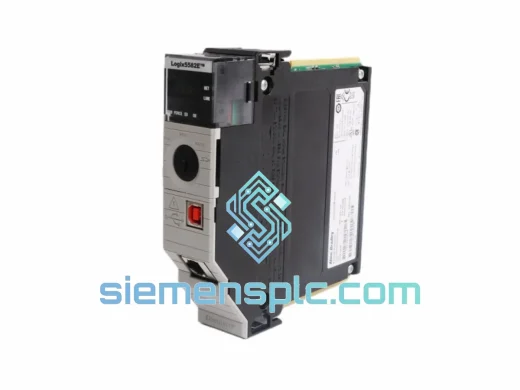
Allen-Bradley 1756-L81E ControlLogix Controller
ControlLogix
Origin US
PLC Controller
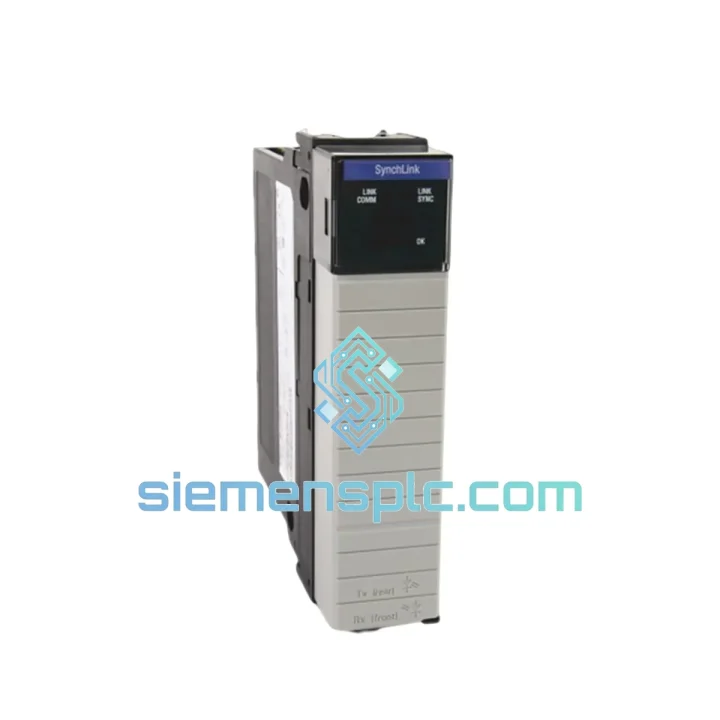
Request verified availability, condition, replacement risk review, packing options and courier lead time for 1756-SYNCH.
Click Request Quote and the part number is inserted into the inquiry form automatically.
Core fields for model confirmation and RFQ routing. Detailed product narrative remains below.
The Allen-Bradley 1756-SYNCH occupies a single slot in any 1756-series chassis and functions as the physical and logical gateway between a ControlLogix backplane and a SynchLink fiber-optic ring. Its primary role in a control loop is to propagate time-stamped synchronization tokens — carrying velocity reference, torque feedforward, and position error data — across chassis boundaries at a fixed 500 µs update rate, independent of the controller scan cycle. This deterministic transport layer is what allows multi-chassis PowerFlex 700S drive arrays to maintain sub-millisecond phase alignment without burdening the EtherNet/IP or ControlNet infrastructure with real-time motion data.
In coordinated winder, extruder, and rolling-mill architectures, the 1756-SYNCH acts as the master arbitration node when configured as the SynchLink hub, or as a transparent relay when configured as a spoke. The module’s internal FPGA handles token-passing arbitration autonomously, offloading the L6x/L7x controller from any SynchLink protocol overhead. The result is a controller CPU utilization reduction of approximately 8–12% in high-axis-count applications compared to equivalent EtherNet/IP-based synchronization schemes.
Real-time Stock & RFQ: [email protected] | WhatsApp: +86 18359268345
| Parameter | Value |
|---|---|
| Catalog Number | 1756-SYNCH |
| Platform | ControlLogix 1756 |
| Module Function | SynchLink Fiber-Optic Communication Bridge |
| SynchLink Update Rate | 500 µs (fixed, deterministic) |
| Physical Medium | Fiber-optic (ST connectors, 820 nm multimode) |
| Max Cable Length (per segment) | 100 m (multimode 62.5/125 µm) |
| Topology | Ring (hub/spoke configurable) |
| Max Nodes per Ring | 8 |
| Backplane Current Draw (5 VDC) | 1.0 A |
| Backplane Current Draw (24 VDC) | 0 mA |
| Operating Temperature | 0 °C to +60 °C |
| Storage Temperature | -40 °C to +85 °C |
| Relative Humidity | 5% to 95% non-condensing |
| Vibration (operating) | IEC 68-2-6: 2 g, 10–500 Hz |
| Shock | IEC 68-2-27: 30 g, 11 ms half-sine |
| Chassis Slot Width | Single slot (1756 standard) |
| Agency Certifications | UL 508, CE (LVD + EMC), C-Tick, IEC 61131-2 |
| Compatible Controllers | 1756-L6x, 1756-L7x, 1756-L8x |
| Compatible Drives | PowerFlex 700S, PowerFlex 700H (SynchLink option) |
| Weight | Approx. 200 g |
| Warranty | 12 months from date of shipment |
The 1756-SYNCH’s internal architecture separates the backplane interface logic from the SynchLink transceiver using a dual-port SRAM buffer. The backplane-side FPGA reads and writes this shared memory at the ControlLogix backplane clock rate (approximately 10 MHz), while the SynchLink-side FPGA services the fiber ring at its own 500 µs token-passing cadence. This architectural isolation means that a backplane stall — caused by a controller task overrun, for example — does not propagate jitter into the SynchLink ring. The ring continues to circulate its synchronization token on schedule, and the backplane FPGA simply presents the most recently committed data block to the controller on its next read cycle.
The fiber-optic transceiver operates at 820 nm on 62.5/125 µm multimode fiber with ST-type connectors. The optical power budget is approximately 11 dB, which accommodates up to 100 m of cable per segment with standard industrial-grade fiber patch assemblies. The receiver incorporates an automatic gain control (AGC) circuit that compensates for connector aging and fiber bend losses over the module’s service life, maintaining a bit error rate below 10⁻¹² under nominal conditions.
EMC performance is a direct consequence of the all-optical signal path. Unlike copper-based synchronization schemes (e.g., RS-422 differential pairs), the SynchLink medium is inherently immune to conducted and radiated electromagnetic interference. The module’s backplane connector and internal PCB traces are the only copper paths, and these are shielded by the 1756 chassis enclosure. The module meets IEC 61000-4-2 (ESD: 4 kV contact / 8 kV air), IEC 61000-4-4 (EFT: 2 kV), and IEC 61000-4-5 (surge: 1 kV) without external filtering, which is significant in drive rooms where 690 V variable-frequency drives generate substantial common-mode noise on cable trays.
The token-passing arbitration logic implements a watchdog timer per node. If a downstream node fails to forward the token within a configurable timeout window (default: 3 × update period = 1.5 ms), the upstream node assumes a ring fault and asserts a diagnostic bit in the module’s status word, which the controller can read via the 1756 backplane. This fault isolation mechanism prevents a single failed node from silently corrupting synchronization data across the entire ring — a critical safety property in coordinated drive applications where a phase error above a defined threshold must trigger a controlled stop.
Every 1756-SYNCH unit supplied through siemensplc.com is sourced from verified industrial distribution channels and undergoes a structured pre-shipment inspection before dispatch from Xiamen, China. Each unit’s catalog label, date code, hardware revision marking, and housing integrity are cross-referenced against Rockwell Automation’s published label specifications. Modules are bench-powered and the firmware revision is confirmed via Studio 5000 device identification prior to packing. A Certificate of Conformance (COC) documenting catalog number, date code, hardware revision, and inspection findings is issued with every shipment as standard.
Packaging follows anti-static ESD protocol: each module is sealed in a conductive poly bag, nested in die-cut foam, and placed in a double-wall corrugated carton with moisture-barrier liner. International shipments are dispatched via DHL Express or FedEx International Priority from Xiamen Gaoqi International Airport, with typical transit times of 3–5 business days to Europe, the Middle East, and Southeast Asia, and 5–7 business days to the Americas. Full export documentation — commercial invoice, packing list, COO declaration, and COC — is provided as standard. DDP and DAP Incoterms are available on request for buyers requiring duty-inclusive pricing.
In-stock units ship within 1–3 business days of order confirmation. A 12-month warranty against defects in materials and workmanship is provided from the date of shipment. Pre-shipment photographs of the actual unit are available at no additional charge for all orders.
Email: [email protected]
WhatsApp: +86 18359268345
Web: siemensplc.com
Location: Xiamen, China
© 2026 siemensplc.com. All rights reserved.
We check the full part number, brand, series and visible nameplate information before quotation.
Sales confirms stock path, condition option, quantity and realistic lead time for export dispatch.
DHL, FedEx, UPS or buyer courier arrangements can be reviewed with packing requirements.
Similar brand or category products for fast comparison and multi-item RFQ lists.