
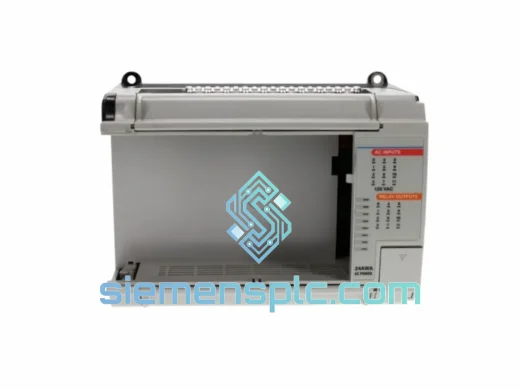
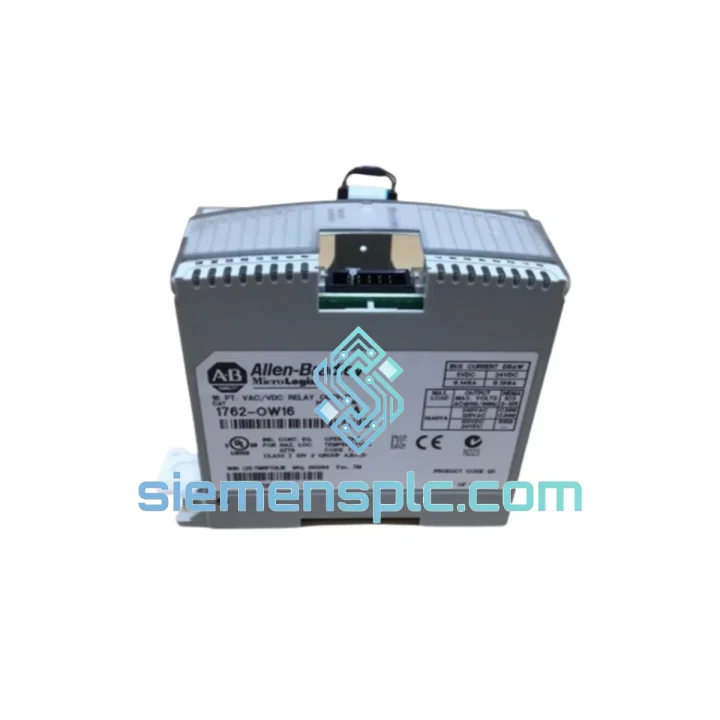
Allen-Bradley
In Stock OK
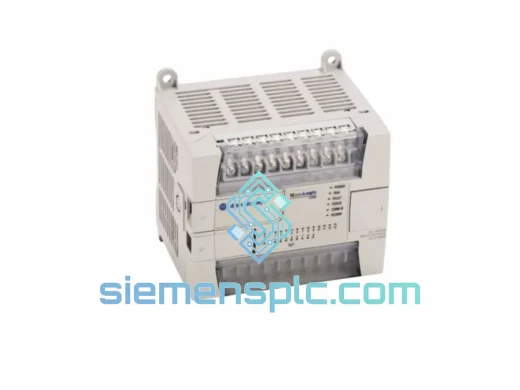
Allen-Bradley 1762-OW16 Relay Output Module
Request verified availability, condition, replacement risk review, packing options and courier lead time for 1762-OW16.
BrandAllen-Bradley
Part Number1762-OW16
ConditionAvailability Check
Lead TimeRFQ Confirmation
DocumentsDatasheet / photos by RFQ
ShippingExport packing available
Auto-filled RFQ
1762-OW16
Click Request Quote and the part number is inserted into the inquiry form automatically.
- Reply by email: [email protected]
- WhatsApp / Tel: +86 18359268345
- Mon-Sat 9:00-18:00 GMT+8
Procurement Data
Key Product Information
Core fields for model confirmation and RFQ routing. Detailed product narrative remains below.
- Brand
- Allen-Bradley
- Primary Part Number
- 1762-OW16
- Product Type
- PLC Relay Output Module
- Series / Family
- MicroLogix
- Manufacturer
- Allen-Bradley (Rockwell Automation)
- Country of Origin
- US
- Catalog Category
- I/O Modules
- Operating Temp.
- 0 °C to +60 °C
- Humidity
- 5–95% RH, non-condensing
Model confirmed for inquiry
1762-OW16
Send quantity, destination and urgency. The RFQ form keeps this part number attached.
Request Quote
Product Overview
1762-OW16 Down? Every Minute of Relay Failure Costs You — Get It Replaced Before the Next Shift
A tripped relay output on the 1762-OW16 doesn’t just kill one output — it can cascade into a full conveyor stop, a solenoid bank lockout, or a motor starter that won’t energize. In food processing, packaging, and water treatment, that translates directly to scrapped batches, missed SLAs, and maintenance crews working overtime chasing a module that should have been on the shelf. The Allen-Bradley 1762-OW16 is a 16-point relay output expansion module purpose-built for MicroLogix 1100 and 1400 controllers. We stock it in Xiamen, we ship it today, and it drops straight onto your 1762 I/O bus without a single line of code change.
URGENT REQUIREMENT? Contact: [email protected] | WhatsApp: +86 18359268345
Quick Technical Datasheet
| Parameter | Specification |
|---|---|
| Part Number | 1762-OW16 |
| Manufacturer | Allen-Bradley (Rockwell Automation) |
| Series | MicroLogix 1762 I/O |
| Output Type | Relay, Form A (SPST-NO) |
| Output Points | 16 |
| Output Voltage Range | 5–265 V AC / 5–125 V DC |
| Max Load Current | 2 A per point / 15 A per common |
| Min Load Current | 10 mA |
| Isolation (Field to Logic) | 1500 V AC |
| Response Time (OFF→ON / ON→OFF) | ≤ 10 ms / ≤ 10 ms |
| Backplane Current Draw | 75 mA @ 5 V DC |
| Operating Temperature | 0 °C to +60 °C |
| Storage Temperature | -40 °C to +85 °C |
| Humidity | 5–95% RH, non-condensing |
| Compatible Controllers | MicroLogix 1100 (1763-L16xxx), MicroLogix 1400 (1766-L32xxx) |
| Certifications | UL, CE, CSA |
| Weight | ~100 g |
| Stock Status | ✅ Ready to Ship — Xiamen Warehouse |
Troubleshooting & Replacement Tips
Most common failure modes on the 1762-OW16 in the field:
1. Relay contact welding (outputs stuck ON)
High-inductive loads — motor starters, solenoid valves — without proper arc suppression will weld relay contacts closed over time. Before swapping the module, check whether the load side has MOV or RC snubber protection. If not, the replacement will fail the same way within months. Fit suppressors across each inductive load before reinstalling.
2. Intermittent output faults (ERR LED flashing, output toggling unexpectedly)
This is almost always a backplane current budget issue. Add up the 5 V DC draw of every module on the 1762 bus. The MicroLogix 1100 controller supplies a maximum of 800 mA; the 1400 varies by model. If you’re at or near the limit, the 1762-OW16’s 75 mA draw tips the system into brownout territory under load. Measure backplane voltage under full I/O scan — anything below 4.75 V DC is your culprit.
3. Module not recognized after installation (I/O tree shows unknown device)
The 1762 bus uses automatic slot addressing — no DIP switches, no manual node configuration. However, RSLogix 500 must have the correct device profile installed. If you’re running RSLogix 500 v7.0 or earlier, the 1762-OW16 profile may not be present. Update to v8.0+ or manually add the device profile from the Rockwell Automation compatibility matrix before going online.
4. Replacement module addressing mismatch
The 1762 I/O bus assigns slot addresses sequentially from the controller outward. If you’re replacing a module mid-chain, the slot number in your RSLogix 500 program must match the physical position. Swapping a module at slot 3 with a new unit at the same physical position requires no program change — but if the chain order changes (e.g., you removed a module to the left), re-verify all downstream slot addresses before going online.
Step-by-step hot-swap procedure:
- Place the MicroLogix controller in Program mode via RSLogix 500 or the keyswitch — do not power down the entire panel if other I/O is live.
- Disconnect field wiring from the 1762-OW16 terminal block. Label each wire before removal — the 16-point terminal layout is dense and mislabeling costs time.
- Release the module locking tabs and slide the 1762-OW16 off the 1762 I/O bus connector. The bus is not hot-swappable on MicroLogix — power down the controller before physically removing the module.
- Seat the replacement 1762-OW16 firmly until both locking tabs click. A partial connection causes intermittent bus faults that are extremely difficult to diagnose.
- Reconnect field wiring. Verify terminal torque: 0.56 N·m (5 lb·in) per Rockwell spec — under-torqued terminals are a leading cause of relay output failures in high-vibration environments.
- Power up the controller. Go online in RSLogix 500 and verify the I/O tree shows the 1762-OW16 at the correct slot with no fault codes.
- Force each output ON/OFF individually and verify field-side continuity before returning to Run mode.
Common fault codes to watch:
- 0x0010 (I/O Module Fault): Module not communicating on bus — check seating and bus connector pins for corrosion.
- 0x0020 (I/O Configuration Mismatch): RSLogix 500 program expects a different module type at this slot — verify device profile and slot address.
- Output LED ON but no field voltage: Relay contact open-circuit failure — module requires replacement, not reset.
Reliability in Harsh Conditions
The 1762-OW16 is rated for continuous operation from 0 °C to +60 °C with 5–95% relative humidity (non-condensing). In practice, field installations push these limits — control cabinets in foundries, outdoor pump stations, and food processing washdown areas routinely exceed the nominal envelope. Here’s what holds up and what doesn’t:
Vibration: The 1762 I/O bus connector is a friction-fit design. In high-vibration environments — compressor rooms, press lines, mobile equipment — the bus connector can work loose over time. Inspect the module seating annually and apply thread-locking compound to the DIN rail mounting screws. Relay contacts are also susceptible to micro-welding under sustained vibration with inductive loads; install arc suppression as standard practice.
Temperature cycling: Repeated thermal expansion and contraction stresses the PCB solder joints on the relay coil drivers. Modules in environments with large daily temperature swings (e.g., outdoor cabinets in continental climates) typically show earlier relay coil failures than those in climate-controlled rooms. If your MTBF is shorter than expected, check cabinet insulation and ventilation before blaming the module.
Humidity and condensation: The 1762-OW16 is not rated for condensing environments. If your cabinet breathes — no positive pressure, no desiccant — moisture ingress will corrode relay contacts and terminal blocks within 18–24 months in coastal or high-humidity regions. Seal cable entries, add desiccant packs, and consider a cabinet heater on a thermostat if ambient humidity regularly exceeds 80% RH.
Every unit we ship has been visually inspected for PCB contamination, relay coil resistance checked, and terminal block integrity verified. We do not ship modules with corroded contacts or damaged bus connectors.
Global Express Logistics
Stock is held at our Xiamen warehouse, positioned for rapid export across Asia-Pacific, the Middle East, Europe, and the Americas. When a plant is down, standard freight timelines are not acceptable — here’s how we move parts:
- Order cutoff: Orders confirmed before 15:00 CST ship same business day via DHL Express or FedEx International Priority.
- Transit times (typical): Southeast Asia 1–2 days | Middle East 2–3 days | Europe 3–4 days | North America 3–5 days | South America 4–6 days.
- Export documentation: Commercial invoice, packing list, and certificate of origin issued with every shipment. HS code 8537.10 pre-classified for customs clearance. ECCN EAR99 — no export license required for most destinations.
- Packaging: Anti-static bag, foam-lined carton, and moisture barrier for all relay output modules. Drop-test rated to ISTA 2A for international air freight.
- Tracking: AWB number provided within 2 hours of dispatch. Real-time tracking link sent directly to your procurement contact.
- Emergency freight: For critical shutdowns, we can arrange hand-carry courier to most major industrial hubs in Asia and the Middle East. Contact us directly to discuss.
We have shipped Allen-Bradley 1762 series modules to petrochemical plants in Saudi Arabia, automotive lines in Thailand, water treatment facilities in Australia, and packaging operations across Europe. The logistics process is documented, repeatable, and fast.
Contact Information
📧 Email: [email protected]
💬 WhatsApp: +86 18359268345
🌐 Web: siemensplc.com
© 2026 siemensplc.com. All rights reserved.
Ready to quote
[email protected]
Send This Part Number to Sales
RFQ workflow
Quality workflow ->
Confirmation Process
01Model confirmation
We check the full part number, brand, series and visible nameplate information before quotation.
02Availability reply
Sales confirms stock path, condition option, quantity and realistic lead time for export dispatch.
03Packing & courier
DHL, FedEx, UPS or buyer courier arrangements can be reviewed with packing requirements.
Continue sourcing
Browse full catalog ->
Related Automation Parts
Similar brand or category products for fast comparison and multi-item RFQ lists.
Allen-Bradley
RFQ Ready
Allen-Bradley 1762-OA8 PLC Output Module – MicroLogix 1762 Series
MicroLogix
Origin US
PLC Output Module
Allen-Bradley
RFQ Ready
Allen-Bradley 1762-L40BWAR Programmable Logic Controller – MicroLogix 1200
MicroLogix
Origin US
Programmable Logic Controller