Basler Electric
RFQ Ready
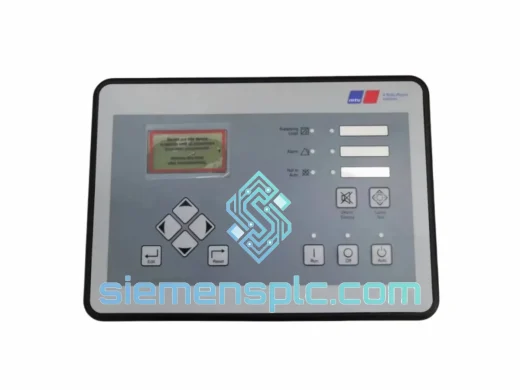
BASLER DGC-2020HD MGC-3020 X59434200300 Digital Genset Controller – DGC Series
Origin Not specified
Digital Genset Controller
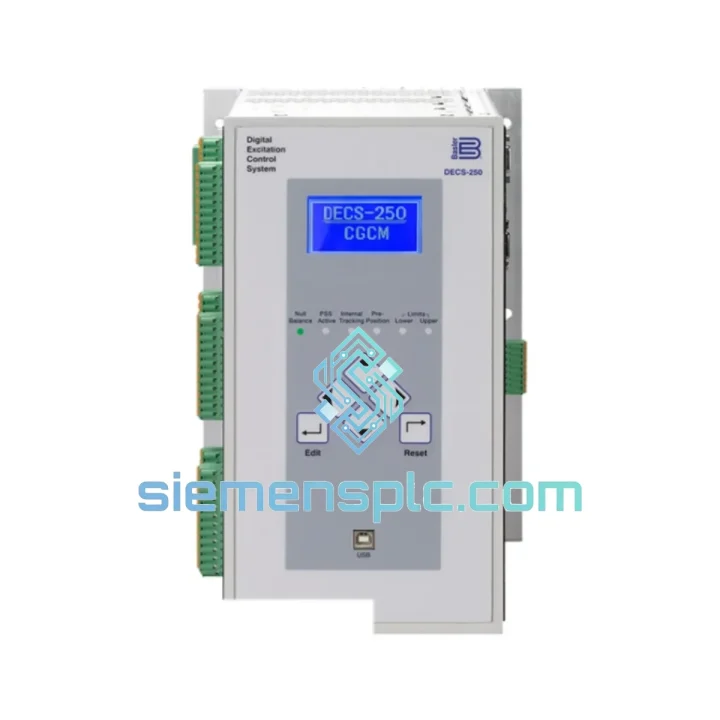
Request verified availability, condition, replacement risk review, packing options and courier lead time for DECS-250-LN2SN1N.
Click Request Quote and the part number is inserted into the inquiry form automatically.
Core fields for model confirmation and RFQ routing. Detailed product narrative remains below.
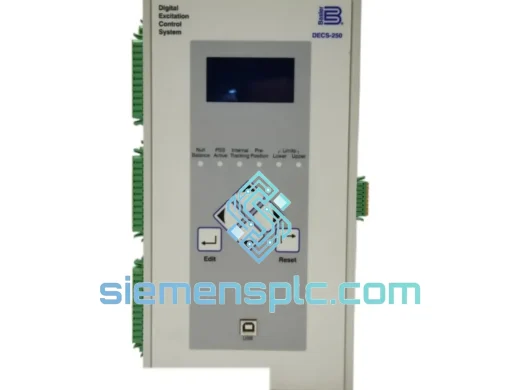
The Basler DECS-250-LN2SN1N is a fully digital automatic voltage regulator (AVR) and excitation control system engineered for synchronous generators operating in utility, industrial, and standby power environments. Within a generator control loop, the excitation controller occupies the most consequential position: it governs field current, which directly determines terminal voltage, reactive power output, and transient stability margin. A poorly specified or degraded AVR introduces voltage deviation, reactive power oscillation, and — in parallel bus configurations — the risk of circulating currents between machines. The DECS-250-LN2SN1N eliminates these failure modes through a microprocessor-based closed-loop architecture with sub-cycle response capability and a comprehensive suite of integrated protection functions.
The suffix LN2SN1N encodes the unit’s specific hardware configuration: single-phase sensing input (L), standard field voltage output range (N2), RS-485 serial communication port (S), standard analog I/O complement (N1), and no optional expansion module fitted (N). Procurement teams must match this suffix precisely to the generator’s excitation topology and panel wiring — substituting an incorrect suffix variant will result in sensing range mismatch or communication incompatibility.
Real-time Stock & RFQ: [email protected] | WhatsApp: +86 18359268345
| Parameter | Specification |
|---|---|
| Manufacturer | Basler Electric |
| Full Part Number | DECS-250-LN2SN1N |
| Product Series | DECS-250 |
| Function | Digital Excitation Control System / Automatic Voltage Regulator |
| Sensing Voltage Input | Single-phase, configurable range (typically 100–240 VAC) |
| Field Voltage Output | Up to 250 VDC continuous; peak forcing voltage higher during transients |
| Voltage Regulation Accuracy | ±0.25% steady-state (no-load to full-load) |
| Control Modes | AVR (Automatic Voltage Regulation), FCR (Field Current Regulation), VAR control, Power Factor control, Droop |
| Parallel Operation | Cross-current compensation and reactive droop for multi-machine bus |
| Communication Interface | RS-485 (Modbus RTU); RS-232 front-panel port for local commissioning |
| Analog Inputs | Remote voltage setpoint, power factor setpoint (configurable) |
| Digital Inputs | Mode selection, raise/lower, fault reset (configurable) |
| Digital Outputs | Alarm relay, fault relay (configurable) |
| Protection Functions | Over-excitation (OEL), under-excitation (UEL), V/Hz limiter, loss-of-sensing, soft-start ramp, over/under voltage |
| Operating Temperature | -40°C to +70°C |
| Storage Temperature | -55°C to +85°C |
| Humidity | 5–95% RH, non-condensing |
| Power Supply (Control) | 18–32 VDC auxiliary input |
| Mounting | Panel mount; DIN rail adapter available |
| Enclosure | Metal chassis, suitable for switchgear panel installation |
| Weight | Approx. 420 g |
| Compliance | CE (LVD + EMC Directive), UL recognized components, IEEE Std 421.5 |
| Configuration Software | Basler BESTCOMS-Plus (PC-based, free download) |
| Warranty | 12 months from shipment date — siemensplc.com guarantee |
| Lead Time | In-stock: ships within 1–3 business days. Ex-stock: quoted within 24 hours |
The DECS-250-LN2SN1N is built around a fixed-point DSP core executing the voltage regulation algorithm at a sampling rate sufficient to detect and respond to terminal voltage deviations within a single AC cycle. This is not a trivial design requirement: at 50 Hz, one cycle spans 20 ms, and the excitation system must sense, compute, and command a corrective field current change within that window to prevent voltage excursion from propagating into the load bus. The DSP architecture achieves this through dedicated hardware multiply-accumulate units that execute the PID compensation loop without software scheduling latency.
EMC and Noise Immunity: Generator control panels are electrically hostile environments. High-energy switching transients from contactors, capacitor banks, and motor starters couple into control wiring through both conducted and radiated paths. The DECS-250-LN2SN1N addresses this through multi-stage input filtering on the sensing voltage lines, optical isolation barriers between the field output stage and the DSP logic domain, and a metal chassis that provides a continuous Faraday shield. The RS-485 communication port uses differential signaling with common-mode rejection, maintaining data integrity in environments where common-mode noise on signal cables routinely exceeds several volts.
Field Output Stage: The power output stage uses a phase-controlled thyristor (SCR) bridge topology. Unlike PWM-based designs, phase control inherently limits high-frequency harmonic injection into the exciter field winding — a meaningful advantage when the exciter is physically close to the generator’s main stator winding and mutual coupling is a concern. The forcing voltage capability allows the controller to drive maximum field current during fault recovery, compressing the voltage recovery time constant and improving transient stability margin.
Over/Under Excitation Limiters (OEL/UEL): These are not simple threshold relays. The OEL implements an inverse-time characteristic that mirrors the thermal capability curve of the rotor winding: brief high-excitation events are permitted (supporting transient stability), while sustained over-excitation is progressively curtailed before thermal damage occurs. The UEL prevents operation in the leading power factor region beyond the generator’s steady-state stability limit, a boundary that is invisible to operators without this protection but can result in pole-slip and loss of synchronism.
V/Hz Limiter: During startup or following a sudden load rejection, terminal voltage can rise while frequency is still below rated. The V/Hz limiter monitors the volts-per-hertz ratio and clamps excitation to prevent core saturation in the generator’s stator iron — a failure mode that causes rapid and irreversible magnetic damage. This function is particularly critical for hydro and gas turbine generators where speed ramp rates are slow.
Parallel Operation Logic: The cross-current compensation circuit compares the reactive current component of the local machine against a bus reference signal. Any imbalance generates a corrective bias on the voltage setpoint, driving reactive load sharing toward equilibrium without requiring a supervisory controller. This peer-level arbitration is inherently more fault-tolerant than centralized VAR dispatch schemes.
Every DECS-250-LN2SN1N unit supplied by siemensplc.com is sourced through verified channels and subjected to a structured pre-shipment inspection protocol. Physical inspection covers label integrity, connector condition, and absence of corrosion or mechanical damage. Where applicable, a functional power-on test confirms that the unit initializes correctly and communication ports respond to query commands. Units are packed in anti-static bags with humidity indicator cards, placed in foam-lined cartons rated for international air freight handling.
Shipments originate from our Xiamen, China operations center. Xiamen is a designated free-trade port with direct air freight connections to major hubs in Europe, North America, Southeast Asia, and the Middle East. Standard international express delivery (DHL / FedEx / UPS) achieves transit times of 3–7 business days to most destinations. For time-critical plant shutdowns, same-day dispatch is available for in-stock units when orders are confirmed before 14:00 CST. All export documentation — commercial invoice, packing list, certificate of origin, and HS code declaration — is prepared in compliance with Xiamen Customs regulations, ensuring smooth clearance at destination ports.
A 12-month warranty covers all units against functional failure under normal operating conditions. Warranty claims are processed with a replacement-first policy: a replacement unit is dispatched before the defective unit is returned, minimizing plant downtime. Multi-currency payment is supported including USD, EUR, HKD, and CNY via T/T bank transfer, PayPal, and other agreed methods.
Email: [email protected]
WhatsApp: +86 18359268345
Web: siemensplc.com
Location: Xiamen, China
© 2026 siemensplc.com. All rights reserved.
We check the full part number, brand, series and visible nameplate information before quotation.
Sales confirms stock path, condition option, quantity and realistic lead time for export dispatch.
DHL, FedEx, UPS or buyer courier arrangements can be reviewed with packing requirements.
Similar brand or category products for fast comparison and multi-item RFQ lists.