Omron
RFQ Ready
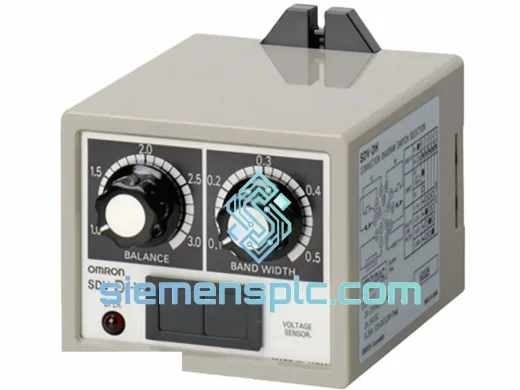
OMRON SDV-DH7/SDV-DH Voltage Sensing Relay
SDV-DH Series
Origin JP
Voltage Sensing Relay
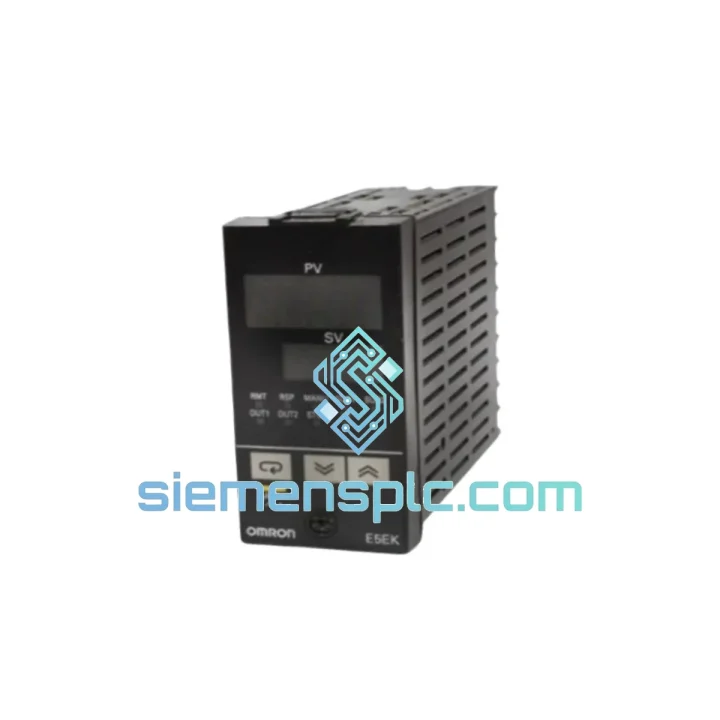
Request verified availability, condition, replacement risk review, packing options and courier lead time for E5EK-PRR2-500.
Click Request Quote and the part number is inserted into the inquiry form automatically.
Core fields for model confirmation and RFQ routing. Detailed product narrative remains below.
The OMRON E5EK-PRR2-500 is a compact 1/8 DIN digital temperature controller built for sustained closed-loop thermal regulation in process industries where measurement accuracy, output reliability, and communication transparency are primary engineering requirements. The unit occupies a 96 × 48 mm panel cutout at a mounting depth of 100 mm, fitting directly into standard IEC 61554 panel openings without adapter hardware. The PRR2 suffix designates dual relay output configuration — one relay dedicated to the proportional control output, one to alarm function — while the 500 suffix identifies the 100–240 VAC universal power supply variant, enabling deployment across global grid standards without voltage-selection jumpers or external transformers.
Input flexibility is a defining characteristic of the E5EK-PRR2-500. The controller accepts eleven thermocouple types — K, J, T, E, L, U, N, R, S, B, and W — covering measurement ranges from −200 °C to +2,300 °C depending on sensor selection. Platinum resistance thermometer inputs support both IEC 751 Pt100 and JIS C 1604 JPt100 calibrations. All input type selection is performed through front-panel parameter menus or RS-485 register writes; no hardware reconfiguration is required when changing sensor types in the field. The analog front-end samples at a 500 ms cycle, delivering a display resolution of 0.1 °C across standard temperature ranges and 1 °C at elevated ranges, providing the measurement granularity required for pharmaceutical batch processes and precision heat-treatment applications.
The PID algorithm implemented in the E5EK-PRR2-500 uses a two-degree-of-freedom (2-DOF) structure that separates the setpoint-tracking response from the disturbance-rejection response into independently tunable gain paths. In a conventional single-degree-of-freedom PID, increasing the proportional gain to improve disturbance rejection simultaneously increases overshoot on setpoint steps — a fundamental constraint that forces engineers to accept a compromise between the two performance objectives. The 2-DOF structure eliminates this constraint: the setpoint-response coefficient (α) scales the proportional and derivative action applied to setpoint changes, while the full PID gain acts on process disturbances. The result is a controller that can achieve fast setpoint tracking with minimal overshoot while maintaining tight disturbance rejection — a combination that reduces thermal stress on workpieces during heat-up and maintains process stability under variable load conditions.
Auto-tuning (AT) is executed on demand via a front-panel key or RS-485 command. The AT algorithm applies a limit-cycle perturbation to the process, measures the resulting oscillation period and amplitude, and computes proportional band (P), integral time (Ti), and derivative time (Td) using the Ziegler-Nichols ultimate-gain method with OMRON’s internal correction factors. The computed parameters are written directly to the active PID group. For processes with well-characterized thermal time constants — such as standardized furnace geometries or validated pharmaceutical autoclaves — manual parameter entry bypasses AT entirely, preserving validated process parameters across controller replacements.
The dual relay output stage uses SPST-NO contacts rated at 250 VAC / 3 A resistive. The control relay operates in time-proportional mode with a configurable cycle time, typically 20–60 seconds for resistive heating elements, balancing switching frequency against contact wear. The alarm relay supports eight independently configurable alarm types: upper-limit, lower-limit, upper-and-lower-limit, deviation upper, deviation lower, deviation upper-and-lower, process-value rate-of-change, and LBA (loop break alarm). The LBA function monitors the relationship between control output and process response; if the process value fails to respond to a sustained control output within a configurable time window, the LBA alarm activates — detecting heater burnout, sensor failure, or broken control wiring without requiring external monitoring hardware.
RS-485 serial communication is integrated as standard, operating under OMRON’s CompoWay/F protocol. Supported baud rates span 1,200 to 19,200 bps with configurable data length, stop bits, and parity. Up to 32 E5EK units share a single RS-485 bus segment using unique station addresses, enabling centralized parameter management and process-value logging from a single PLC serial port. The protocol supports both parameter read/write and run/stop command functions, allowing full remote operation without front-panel access — a requirement in sealed enclosures and remote process skids. Modbus RTU access is achievable through protocol converters, extending compatibility to SCADA systems and HMI platforms that do not natively support CompoWay/F.
The front panel carries an IP66 ingress protection rating per IEC 60529, qualifying the unit for washdown environments in food processing, beverage production, and pharmaceutical manufacturing where periodic high-pressure water cleaning is a standard sanitation procedure. The rear terminal block is accessible from the panel interior, maintaining the IP66 boundary at the operator interface while permitting field wiring changes without disturbing the front gasket seal.
Multi-SP functionality stores up to eight independent setpoint groups, each switchable via external dry-contact inputs on the controller’s terminal block. This architecture supports multi-recipe production lines where thermal profiles differ between product variants: a single E5EK-PRR2-500 manages all recipe setpoints internally, with recipe selection driven by PLC digital outputs or manual switches, eliminating SCADA setpoint writes during changeover and reducing recipe-transition time to the contact-switching latency of the PLC output module.
Real-time Stock & RFQ: [email protected] | WhatsApp: +86 18359268345
| Parameter | Specification |
|---|---|
| Model Number | E5EK-PRR2-500 |
| Manufacturer | OMRON Corporation (Japan) |
| Product Series | E5EK |
| Form Factor | 1/8 DIN — 96 mm (W) × 48 mm (H), panel depth 100 mm |
| Panel Cutout | 92 mm × 45 mm (IEC 61554 compliant) |
| Supply Voltage | 100–240 VAC, 50/60 Hz (±10% tolerance) |
| Power Consumption | 8 VA maximum |
| Control Output | Relay SPST-NO, 250 VAC / 3 A resistive load |
| Alarm Output | Relay SPST-NO, 250 VAC / 3 A resistive load |
| Thermocouple Input Types | K, J, T, E, L, U, N, R, S, B, W (IEC / JIS) |
| RTD Input Types | Pt100 (IEC 751), JPt100 (JIS C 1604) |
| Measurement Resolution | 0.1 °C (standard range) / 1 °C (high-temperature range) |
| Sampling Period | 500 ms |
| Control Algorithm | 2-DOF PID / ON-OFF (selectable) |
| Auto-Tuning Method | Limit-cycle, demand-triggered |
| Setpoint Groups (Multi-SP) | 8 groups, external dry-contact switchable |
| Alarm Types | 8 configurable types including LBA, deviation, rate-of-change |
| Communication Interface | RS-485, CompoWay/F protocol |
| Baud Rate Range | 1,200 – 19,200 bps |
| Max. Bus Nodes | 32 units per RS-485 segment |
| Display | Dual 4-digit red LED (PV upper / SV lower) |
| Front Panel Protection | IP66 (IEC 60529) |
| Operating Temperature | −10 to +55 °C |
| Storage Temperature | −25 to +65 °C |
| Relative Humidity | 25–85% RH, non-condensing |
| Unit Weight | Approx. 200 g |
| Country of Origin | Japan |
| Warranty | 12 months from shipment date |
The analog input stage of the E5EK-PRR2-500 uses a multiplexed architecture feeding a 16-bit successive-approximation A/D converter. Thermocouple cold-junction compensation is performed by a dedicated NTC thermistor mounted at the rear terminal block, with compensation coefficients applied in firmware at every 500 ms sampling interrupt. This approach tracks real-time terminal temperature variation — a critical distinction from fixed-table compensation methods, which introduce systematic measurement error when panel interior temperature drifts by more than 5–10 °C from the calibration reference. In control panels where power dissipation from adjacent drives or transformers creates a 15–25 °C thermal gradient across the panel height, real-time cold-junction compensation maintains thermocouple measurement accuracy within the specified ±0.5% FS tolerance.
The relay output switching circuit incorporates zero-crossing detection for AC load control. The relay coil is energized only when the AC supply voltage passes through zero, reducing the inrush current transient into resistive heating elements at contact closure. For a 3 A resistive load at 240 VAC, zero-crossing switching reduces the peak inrush current from the theoretical maximum (limited only by contact and wiring resistance) to a value determined by the load impedance at the zero-crossing instant — typically reducing contact erosion rate by 30–50% compared to random-phase switching. This extends relay mechanical life beyond the rated 100,000 operations under typical time-proportional duty cycles with 30-second cycle times.
EMC architecture at the PCB level separates the analog input signal path from the relay switching circuitry using a dedicated ground plane layer. The RS-485 transceiver incorporates ±15 kV ESD protection on the A and B bus lines, protecting the communication interface against electrostatic discharge events during field wiring operations. The AC power input passes through a common-mode choke before the bridge rectifier, attenuating conducted interference from the supply line in the frequency range 150 kHz–30 MHz. The unit carries CE marking under the EMC Directive (EN 61326-1, industrial environment) and the Low Voltage Directive (EN 61010-1), confirming that the design meets the electromagnetic emission and immunity requirements applicable to industrial control panel installations.
The firmware task scheduler separates the PID computation interrupt from the RS-485 communication handler. The PID loop executes at a fixed 500 ms hardware timer interrupt with non-preemptible priority, ensuring that the control output update cycle is not delayed by communication processing. RS-485 frame reception and transmission are handled in a lower-priority interrupt context. This architecture prevents the communication latency inherent in multi-node polling sequences — which can reach 200–400 ms under 32-node bus loading at 9,600 bps — from introducing timing jitter into the control output, a failure mode that manifests as irregular cycle times and increased process variable variance in time-proportional control applications.
All OMRON E5EK-PRR2-500 units dispatched from siemensplc.com are sourced through verified industrial supply channels and subject to pre-shipment inspection covering label authenticity verification, firmware version confirmation against the current OMRON release, packaging seal integrity check, and physical condition assessment. Units are individually packed in anti-static polyethylene bags with silica gel desiccant and moisture-barrier outer cartons rated for air freight and sea freight transit durations of up to 45 days. Batch traceability records — including supplier lot reference, inspection date, and inspector ID — are retained for each shipment. Certificates of conformity and commercial invoices are issued with every order to support procurement documentation and customs clearance requirements.
Logistics operations are based in Xiamen, Fujian Province, China — a primary export hub with direct access to DHL, FedEx, UPS, and TNT international express services, as well as consolidated sea freight connections to major ports in Europe, North America, Southeast Asia, the Middle East, and Australia. Standard international air express transit times are 3–7 business days to most destinations. In-stock orders confirmed before 14:00 CST are eligible for same-day dispatch. All shipments include end-to-end tracking numbers and full commercial documentation. The 12-month warranty covers manufacturing defects from the shipment date; warranty claims are processed with replacement unit dispatch or credit note issuance within 5 business days of defect confirmation.
Email: [email protected]
WhatsApp: +86 18359268345
Web: siemensplc.com
Location: Xiamen, China
© 2026 siemensplc.com. All rights reserved.
We check the full part number, brand, series and visible nameplate information before quotation.
Sales confirms stock path, condition option, quantity and realistic lead time for export dispatch.
DHL, FedEx, UPS or buyer courier arrangements can be reviewed with packing requirements.
Similar brand or category products for fast comparison and multi-item RFQ lists.