Siemens
RFQ Ready
Siemens T8191 Safety Controller Module – Trusted TMR Series
Trusted Series
Origin DE
Safety Controller Module
Request verified availability, condition, replacement risk review, packing options and courier lead time for 16207-61/13.
Click Request Quote and the part number is inserted into the inquiry form automatically.
Core fields for model confirmation and RFQ routing. Detailed product narrative remains below.
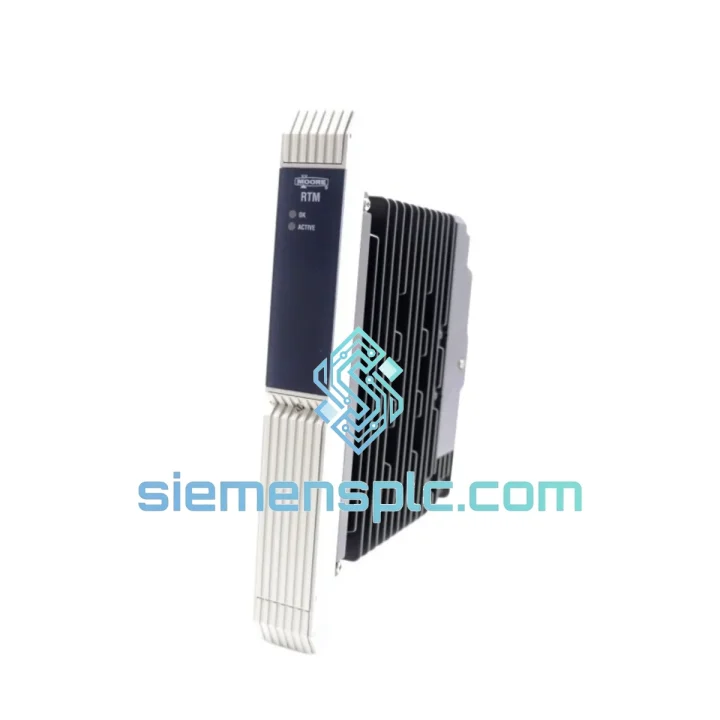
The Siemens 39RTMCAN (Order No. 16207-61/13) is a dedicated resistance temperature measurement module engineered for integration within the TELEPERM XS and TELEPERM XP distributed control system platforms. Its primary function is the acquisition, linearization, and transmission of resistance-based temperature sensor signals — Pt100, Pt1000, Ni100, and Cu10 — directly into the DCS automation station via a CAN-bus backplane interface. In process industries where thermal measurement accuracy directly governs product quality, equipment protection, and regulatory compliance, this module occupies a structurally non-negotiable position in the control loop architecture.
Unlike universal analog input cards that apply software-based RTD emulation, the 39RTMCAN implements dedicated resistance measurement circuitry at the hardware level. This design choice eliminates the linearization offset errors and conversion latency that accumulate in multi-function I/O cards when handling low-resistance RTD signals. The result is a measurement chain with tighter accuracy tolerance across the full operating temperature range, which is particularly relevant in applications such as turbine exhaust monitoring, reactor temperature profiling, and heat-exchanger outlet supervision where ±0.5 °C drift can trigger protective shutdowns or process deviations.
Real-time Stock & RFQ: [email protected] | WhatsApp: +86 18359268345
| Manufacturer | Siemens AG |
| Part Number / SKU | 39RTMCAN |
| Order Number | 16207-61/13 |
| Module Classification | RTM – Resistance Temperature Module |
| Compatible DCS Platform | TELEPERM XS / TELEPERM XP |
| Supported Sensor Types | Pt100, Pt1000, Ni100, Cu10 (2-wire, 3-wire, 4-wire RTD) |
| Backplane Communication | CAN Bus (Controller Area Network), deterministic frame scheduling |
| Supply Voltage | 24 VDC nominal, supplied via DCS I/O rack backplane |
| Operating Temperature Range | 0 °C to +60 °C ambient |
| Storage Temperature Range | −25 °C to +70 °C |
| Isolation | Galvanic channel-to-backplane isolation |
| Compliance Standards | CE marking, IEC 61131-2 |
| Module Weight | Approx. 1,900 g |
| Country of Origin | Germany |
| Warranty | 12 months from date of shipment |
The 39RTMCAN’s internal architecture is structured around three functional stages: sensor excitation, resistance-to-digital conversion, and CAN-bus frame assembly.
Sensor Excitation Circuit: The module generates a precision constant-current excitation signal applied to the RTD element. By controlling excitation current with high stability, the module ensures that self-heating of the sensor element remains within the manufacturer’s specified tolerance, preventing measurement offset caused by I²R heating — a common failure mode in poorly designed RTD front-ends operating at elevated ambient temperatures.
Resistance-to-Digital Conversion: A dedicated sigma-delta ADC architecture is employed for resistance measurement. This topology provides high oversampling ratios that suppress 50/60 Hz power-line interference natively at the conversion stage, reducing dependence on external filtering components. The sigma-delta approach also delivers high effective resolution across the narrow resistance span of Pt100 sensors (approximately 18 Ω across a 0–100 °C range), where a conventional successive-approximation ADC would sacrifice resolution.
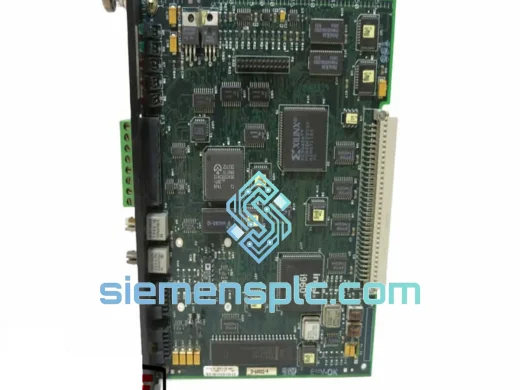
EMC Design: The module’s PCB layout incorporates ground-plane segmentation between the analog measurement section and the digital CAN transceiver section. Ferrite bead filtering on the backplane power rails attenuates high-frequency switching noise injected by adjacent modules. The CAN transceiver itself operates with common-mode rejection sufficient to handle the ground potential differences typical in large industrial cabinets where cable runs span multiple earthing zones.
CAN Bus Frame Assembly: Measured temperature values are packaged into CAN data frames with fixed message identifiers assigned by the TELEPERM rack configuration. The deterministic CAN arbitration protocol guarantees that temperature data from the 39RTMCAN reaches the automation station CPU within a bounded cycle time, regardless of bus load from other I/O modules — a property essential for thermal protection loops with defined response-time requirements.
Redundancy Support: The TELEPERM XS/XP architecture supports pairing two 39RTMCAN modules in a primary/standby configuration. The system software manages arbitration between the two modules, switching to the standby unit upon detection of a primary module fault without interrupting the process measurement chain. This hardware-level redundancy is distinct from software-based fault masking and provides genuine measurement continuity during module replacement.
Every 39RTMCAN unit supplied by siemensplc.com is sourced through verified industrial channels and subjected to a structured pre-shipment inspection protocol. Visual inspection confirms label integrity — part number, order number, date code, and firmware revision marking — against Siemens production records. Functional power-on testing verifies backplane communication initialization and channel self-diagnostic completion. Units exhibiting any anomaly in the diagnostic sequence are quarantined and excluded from inventory.
Packaging follows ESD-safe handling standards: each module is sealed in an anti-static bag, cushioned in foam-lined carton, and accompanied by a humidity indicator card for long-haul freight monitoring. A certificate of conformance and test report are available upon request for regulated industries including nuclear, pharmaceutical, and offshore oil and gas.
Logistics operations are based in Xiamen, China, with direct access to international express freight networks. DHL Express, FedEx International Priority, and SF Express international services are available, with typical transit times of 3–7 business days to Europe, North America, Southeast Asia, and the Middle East. Customs documentation — commercial invoice, packing list, and HS code declaration — is prepared to the destination country’s import requirements to minimize clearance delays. For time-critical plant shutdowns, same-day dispatch is available for in-stock units when orders are confirmed before 14:00 CST.
Email: [email protected]
WhatsApp: +86 18359268345
Web: siemensplc.com
Location: Xiamen, China
© 2026 siemensplc.com. All rights reserved.
We check the full part number, brand, series and visible nameplate information before quotation.
Sales confirms stock path, condition option, quantity and realistic lead time for export dispatch.
DHL, FedEx, UPS or buyer courier arrangements can be reviewed with packing requirements.
Similar brand or category products for fast comparison and multi-item RFQ lists.