Siemens
RFQ Ready
Siemens A5E03378158 Communication Processor – SIMATIC S7-300 CP 343-1
SIMATIC S7-300
Origin DE
Communication Processor
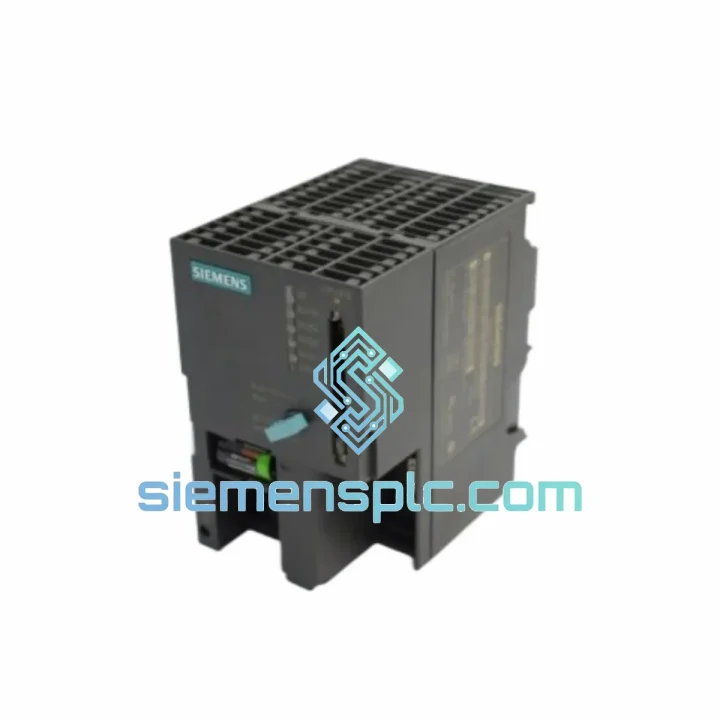
Request verified availability, condition, replacement risk review, packing options and courier lead time for 6ES7315-1AF03-0AB0.
Click Request Quote and the part number is inserted into the inquiry form automatically.
Core fields for model confirmation and RFQ routing. Detailed product narrative remains below.
The 6ES7315-1AF03-0AB0 is a mid-range central processing unit within the SIMATIC S7-300 modular PLC platform. Its role in a control loop is to execute the cyclic scan — reading physical input states from signal modules via the S7-300 backplane bus, processing the user program stored in work memory, and writing output commands back to actuator-side modules within a deterministic cycle time. Unlike higher-tier CPUs in the S7-300 family, this unit operates exclusively over the MPI (Multi-Point Interface) at 187.5 kbps, making it the correct specification for standalone machine control and small-to-medium distributed I/O stations where PROFIBUS DP or PROFINET overhead is neither required nor justified.
The CPU’s 48 KB work memory is partitioned symmetrically between program code and data objects, allowing structured programming with a clear separation of logic blocks (OBs, FBs, FCs) and instance data blocks. The integrated 80 KB RAM load memory is supplemented by a Micro Memory Card (MMC) slot accepting cards up to 4 MB — a critical feature for recipe-driven production lines where program variants must be swapped without a programming device. The MMC also serves as the non-volatile backup medium: on power loss, the CPU retains the program on the card and reloads it automatically on the next power-up cycle, eliminating the need for battery-backed SRAM in most applications.
The backplane bus of the S7-300 rack operates as a parallel, synchronous data highway connecting the CPU to up to eight signal modules per rack. The 6ES7315-1AF03-0AB0 arbitrates this bus as the sole master, polling each module’s process image during the input phase of the scan cycle. The process image input (PII) and process image output (PIQ) are updated atomically at the start and end of each OB1 cycle respectively, ensuring that all logic within a single scan sees a consistent snapshot of the physical process — a fundamental requirement for deterministic ladder and function block execution.
Instruction throughput is rated at 0.3 ms per 1,000 binary instructions, which translates to a practical OB1 cycle time of 5–15 ms for typical machine programs of 10,000–50,000 instructions. Time-critical interrupt routines can be assigned to OB35 (cyclic interrupt, configurable from 1 ms to 60,000 ms) or OB40 (hardware interrupt), allowing the CPU to respond to edge-triggered process events — such as encoder zero-pulse detection or emergency stop activation — outside the main scan cycle with sub-millisecond latency.
Real-time Stock & RFQ: [email protected] | WhatsApp: +86 18359268345
| Parameter | Value |
|---|---|
| Part Number | 6ES7315-1AF03-0AB0 |
| Series | SIMATIC S7-300 |
| Module Type | CPU 315 — Central Processing Unit |
| Work Memory (Program) | 48 KB |
| Work Memory (Data) | 48 KB |
| Load Memory (Integrated RAM) | 80 KB |
| Load Memory (MMC, max) | 4 MB (Micro Memory Card) |
| Binary Instruction Processing | 0.3 ms / 1,000 instructions |
| Floating-Point Processing | 0.6 ms / 1,000 instructions |
| Max Digital I/O | 1,024 DI / 1,024 DO |
| Max Analog I/O | 256 AI / 256 AO |
| Communication Interface | MPI, 187.5 kbps |
| MPI Stations (max) | 32 |
| Programming Software | STEP 7 v5.4 or higher (Classic) |
| Programming Languages | LAD, FBD, STL, S7-Graph, S7-HiGraph |
| Supply Voltage | 24 V DC (via PS 307 power supply) |
| Current Consumption (5 V bus) | 1.1 A |
| Power Dissipation (typical) | 4.0 W |
| Operating Temperature | 0 °C to +60 °C |
| Storage Temperature | –40 °C to +70 °C |
| Relative Humidity | 10 % to 95 % (non-condensing) |
| Protection Rating | IP20 |
| Dimensions (W × H × D) | 40 × 125 × 130 mm |
| Weight | Approx. 290 g |
| Certifications | CE, UL, cULus, ATEX Zone 2 (IIC T4) |
| Warranty | 12 months against manufacturing defects |
The 6ES7315-1AF03-0AB0 implements a single-chip microprocessor architecture with on-chip cache and a dedicated co-processor for floating-point arithmetic. The backplane bus interface logic is implemented in a custom ASIC that handles bus arbitration, module addressing, and process image transfer independently of the main CPU core — meaning backplane I/O polling does not consume instruction execution cycles, preserving the rated 0.3 ms/1K throughput under full I/O load.
EMC Design: The CPU housing is a die-cast aluminum shield bonded to the DIN rail ground bus through the rack’s mechanical mounting clip. Internal PCB layers include a dedicated ground plane separating the 5 V logic domain from the 24 V DC input domain. All external signal lines entering the MPI port are protected by transient voltage suppression (TVS) diodes rated to IEC 61000-4-5 (surge immunity, 1 kV line-to-line). The module meets EN 61000-6-2 industrial immunity class, covering 10 V/m radiated field immunity (IEC 61000-4-3) and 4 kV EFT/burst immunity (IEC 61000-4-4).
Memory Architecture: Work memory is implemented as fast SRAM with zero wait-state access at the CPU’s internal bus frequency. The MMC interface uses a dedicated SPI-compatible controller that operates asynchronously to the scan cycle — card read/write operations during program download do not introduce jitter into the running OB1 cycle. The CPU distinguishes between retentive and non-retentive data areas in the data block address space; retentive markers (M bits) and DB contents flagged as retentive are preserved across power cycles via the MMC, while non-retentive areas are initialized to zero on each cold restart.
Interrupt Handling: The CPU supports a full OB priority hierarchy from OB1 (lowest, cyclic) through OB121/OB122 (programming/I/O access errors). Hardware interrupt OBs (OB40–OB47) are triggered by configurable rising/falling edges on digital input modules, with a maximum interrupt response time of 0.5 ms from edge detection to OB entry — sufficient for high-speed counting and position-capture applications when used with FM 350 counter modules.
Diagnostic Transparency: The CPU maintains a 100-entry diagnostic buffer in retentive memory, logging module faults, power failures, and program errors with timestamps referenced to the internal real-time clock (RTC). The RTC is battery-free on this model; time synchronization is performed via MPI from a connected STEP 7 programming station or HMI panel at each power-up.
Every 6ES7315-1AF03-0AB0 unit dispatched from our Xiamen, China facility passes a structured pre-shipment verification protocol. Visual inspection covers housing integrity, label authenticity against OEM reference markings, connector pin geometry, and factory seal condition. Each CPU is powered on a test bench with a PS 307 supply and a STEP 7 station to confirm firmware version readout, diagnostic buffer access, and MPI communication handshake — functional tests that counterfeit units consistently fail.
Packaging follows IEC 61340-5-1 ESD control requirements: the module is placed in a conductive anti-static bag, heat-sealed, and cushioned with 25 mm polyethylene foam inside a double-wall corrugated carton rated to 32 ECT. Shipments to Europe, North America, Southeast Asia, and the Middle East are dispatched via DHL Express or FedEx International Priority, with typical transit times of 3–7 business days from Xiamen Gaoqi International Airport. Commercial invoice, packing list, and certificate of origin documentation are prepared to facilitate customs clearance in all major import jurisdictions.
A 12-month warranty covers manufacturing defects from the date of dispatch. Dead-on-arrival (DOA) units confirmed within 7 business days of receipt are replaced at no charge, with return freight covered. Warranty claims are processed via email with photographic evidence of the fault condition; replacement units are dispatched within 2 business days of claim approval.
Email: [email protected]
WhatsApp: +86 18359268345
Web: siemensplc.com
Location: Xiamen, China
© 2026 siemensplc.com. All rights reserved.
We check the full part number, brand, series and visible nameplate information before quotation.
Sales confirms stock path, condition option, quantity and realistic lead time for export dispatch.
DHL, FedEx, UPS or buyer courier arrangements can be reviewed with packing requirements.
Similar brand or category products for fast comparison and multi-item RFQ lists.