Siemens
In Stock OK
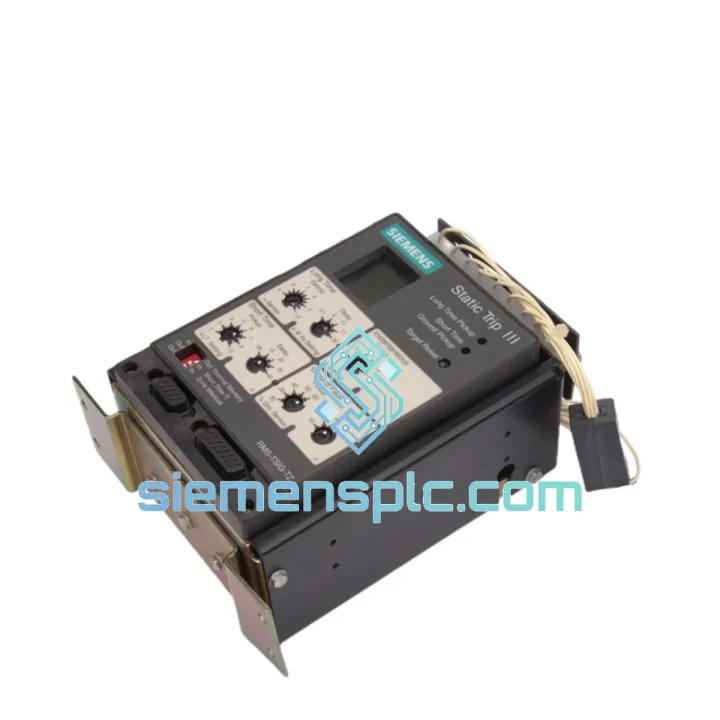
SIEMENS RMS-TSIG-TZ Electronic Trip Unit
Request verified availability, condition, replacement risk review, packing options and courier lead time for RMS-TSIG-TZ.
BrandSiemens
Part NumberRMS-TSIG-TZ
ConditionAvailability Check
Lead TimeRFQ Confirmation
DocumentsDatasheet / photos by RFQ
ShippingExport packing available
Auto-filled RFQ
RMS-TSIG-TZ
Click Request Quote and the part number is inserted into the inquiry form automatically.
- Reply by email: [email protected]
- WhatsApp / Tel: +86 18359268345
- Mon-Sat 9:00-18:00 GMT+8
Procurement Data
Key Product Information
Core fields for model confirmation and RFQ routing. Detailed product narrative remains below.
- Brand
- Siemens
- Primary Part Number
- RMS-TSIG-TZ
- Product Type
- Electronic Trip Unit
- Product Family
- Other series
- Country of Origin
- DE
- Catalog Category
- Relays & Protection
- Operating Temp.
- -25°C to +70°C (solid-state, no bimetallic drift)
- Warranty
- 12 months from date of dispatch
Model confirmed for inquiry
RMS-TSIG-TZ
Send quantity, destination and urgency. The RFQ form keeps this part number attached.
Request Quote
Product Overview
SIEMENS RMS-TSIG-TZ: A Procurement Manager’s Guide to Securing This Critical Protection Asset
In industrial power distribution, the trip unit is not a commodity — it is the decision-making core of your circuit breaker. When procurement teams treat the RMS-TSIG-TZ as an interchangeable line item, they expose their operations to a chain of risks that extend far beyond the unit price: unplanned downtime, protection miscoordination, and the compounding cost of emergency sourcing under pressure. This page is written for engineers and supply chain professionals who need to make a defensible, cost-justified procurement decision — not just place an order.
The SIEMENS RMS-TSIG-TZ is a solid-state electronic trip unit engineered for the SENTRON series of molded case and air circuit breakers. Its defining characteristic is true RMS current measurement combined with time-zone (TZ) selective delay coordination — a combination that makes it indispensable in facilities where harmonic-rich loads, variable frequency drives, and layered protection schemes coexist. Unlike thermal-magnetic alternatives, the RMS-TSIG-TZ delivers temperature-independent, repeatable trip thresholds across the full ambient range, eliminating the calibration drift that plagues bimetallic units in high-ambient environments such as outdoor substations, foundries, and tropical-climate installations.
From a supply chain perspective, the RMS-TSIG-TZ occupies a nuanced position: it is not a high-volume consumable, yet it is not so rare that lead times are measured in months. For most industrial markets, it sits in the category of a strategically important spare — stocked in small quantities by authorized distributors, but subject to allocation pressure during periods of high demand or supply disruption. This means that procurement teams who wait until failure to source a replacement will almost always pay a premium, either in unit cost or in expedited freight. The correct strategy is proactive positioning: identify your installed base, calculate your mean time between replacements, and establish a qualified secondary supplier before you need one.
Request an Official Quote: [email protected] | WhatsApp: +86 18359268345
Procurement Specifications
| Brand | SIEMENS |
| Full Part Number / SKU | RMS-TSIG-TZ |
| Series | SENTRON |
| Component Type | Electronic Trip Unit (Static Trip Module) |
| Sensing Technology | True RMS current measurement |
| Protection Functions | Overload (L), Short-circuit (I), Ground fault (G) — configuration dependent |
| Coordination Method | Time-zone (TZ) selective delay — zone-selective interlocking (ZSI) capable |
| Standards | IEC 60947-2 |
| Operating Temperature | -25°C to +70°C (solid-state, no bimetallic drift) |
| Unit Weight | 1,600 g |
| Country of Origin | Germany |
| Typical Lead Time (Ex-Stock) | 3–7 business days (subject to availability confirmation) |
| Typical Lead Time (Factory Order) | 6–14 weeks (for allocation or discontinued batches) |
| Minimum Order Quantity | 1 unit (bulk pricing available — contact for volume schedule) |
| Warranty | 12 months from date of dispatch |
Lead times are indicative and subject to real-time stock confirmation. Submit an RFQ for a binding availability and delivery commitment.
Total Cost of Ownership (TCO) Analysis
Procurement decisions evaluated on unit price alone systematically underestimate the true cost of industrial protection components. For the RMS-TSIG-TZ, a rigorous TCO framework must account for four cost vectors that dwarf the acquisition price over a five-year horizon.
1. Downtime Cost Avoidance. A single unplanned outage in a continuous-process facility — petrochemical, food processing, semiconductor fabrication — typically costs between USD 50,000 and USD 500,000 per hour when production loss, labor, and restart costs are aggregated. A failed or miscalibrated trip unit that causes a nuisance trip or, worse, fails to trip on a genuine fault, is a direct trigger for this category of loss. The RMS-TSIG-TZ’s solid-state architecture eliminates the mechanical wear and thermal drift that cause bimetallic units to deviate from their calibrated thresholds over time. The cost of one avoided nuisance trip in a critical process line will typically recover the unit cost of the RMS-TSIG-TZ many times over.
2. Maintenance Labor Reduction. Thermal-magnetic trip units require periodic calibration verification and are sensitive to ambient temperature changes that can shift their effective trip point by 10–20% over a wide temperature range. The RMS-TSIG-TZ’s solid-state design eliminates this maintenance burden. For facilities with large installed bases of SENTRON breakers, the cumulative reduction in scheduled maintenance labor represents a meaningful OPEX saving over a three-to-five-year maintenance cycle.
3. Emergency Sourcing Premium Elimination. When a trip unit fails without a qualified spare on hand, procurement teams are forced into the spot market — paying 30–80% premiums over standard pricing, plus expedited freight costs that can equal or exceed the component cost itself. Establishing a pre-qualified supply relationship with siemensplc.com before a failure event converts this unpredictable emergency cost into a planned, budgeted spare parts expense. The 12-month warranty provided on every unit further reduces the risk of early-life failure costs falling on the buyer.
4. Protection Coordination Integrity. The TZ selective delay function of the RMS-TSIG-TZ enables zone-selective interlocking, ensuring that only the breaker closest to a fault trips — not the upstream main breaker. In facilities without proper ZSI coordination, a fault at a sub-distribution board can black out an entire production floor. The cost of a facility-wide outage versus a localized panel outage is not linear — it is exponential. Specifying the correct trip unit with TZ capability is a capital investment in protection architecture that pays dividends every time a fault occurs and is correctly isolated.
When these four vectors are modeled over a five-year period, the RMS-TSIG-TZ consistently demonstrates a total cost of ownership that is substantially lower than lower-specification alternatives, even when the acquisition price of those alternatives is significantly less. The math is straightforward: one avoided major fault event or one avoided emergency sourcing episode recovers years of the cost differential.
Quality & Compliance Assurance
Every RMS-TSIG-TZ unit dispatched from siemensplc.com is subject to a documented verification protocol before it leaves our facility. We operate on a 100% genuine product commitment — no grey-market substitutions, no remarked components, no counterfeit risk. Our supply chain traces directly to authorized distribution channels with full provenance documentation available on request.
All export transactions are processed through Xiamen Customs in full compliance with Chinese export regulations and international trade law. We provide complete customs documentation packages including commercial invoice, packing list, certificate of origin, and — where required — export license documentation. This compliance posture protects our buyers from customs delays, import holds, and the reputational risk associated with non-compliant supply chains.
Payment flexibility is a core part of our service offering. We support multiple currencies and payment methods including USD, EUR, HKD, and CNY, with settlement options via T/T bank transfer, L/C (letter of credit) for large orders, and other B2B arrangements for qualified buyers. Our finance team can structure payment terms appropriate to your procurement cycle and project timeline.
Strategic Sourcing from Xiamen
Xiamen is not an arbitrary logistics point — it is one of China’s five original Special Economic Zones and a designated international shipping hub with direct container routes to major ports across Southeast Asia, Europe, the Middle East, and the Americas. Xiamen Gaoqi International Airport provides daily cargo connections to Hong Kong, Singapore, Dubai, and Frankfurt, enabling air freight delivery to most global destinations within 3–5 business days.
For buyers in Southeast Asia — a region with rapidly expanding industrial automation investment — Xiamen’s geographic position translates to freight cost advantages of 15–30% compared to sourcing from European or North American distribution centers, with comparable or faster transit times to regional ports including Singapore, Jakarta, Ho Chi Minh City, and Manila. For Middle Eastern and African buyers, Xiamen’s established sea freight lanes to Jebel Ali and Durban provide cost-effective bulk shipment options for multi-unit orders.
Our logistics team manages the full export process: freight booking, customs clearance, insurance, and door-to-door tracking. We work with DHL Express, FedEx International Priority, UPS Worldwide, and multiple sea freight consolidators, giving buyers the flexibility to optimize between speed and cost based on their project urgency and budget constraints.
Contact Information
Email: [email protected]
WhatsApp: +86 18359268345
Web: siemensplc.com
© 2026 siemensplc.com. All rights reserved.
Ready to quote
[email protected]
Send This Part Number to Sales
RFQ workflow
Quality workflow ->
Confirmation Process
01Model confirmation
We check the full part number, brand, series and visible nameplate information before quotation.
02Availability reply
Sales confirms stock path, condition option, quantity and realistic lead time for export dispatch.
03Packing & courier
DHL, FedEx, UPS or buyer courier arrangements can be reviewed with packing requirements.
Continue sourcing
Browse full catalog ->
Related Automation Parts
Similar brand or category products for fast comparison and multi-item RFQ lists.
Siemens
RFQ Ready
Siemens 6ES7214-2AD23-0XB0 PLC CPU Module – S7-200 SMART
SIMATIC
Origin DE
PLC CPU Module
Siemens
RFQ Ready
SIEMENS 6ES7214-1HG40-0XB0 PLC CPU Module
SIMATIC S7-1200
Origin DE
PLC CPU Module