Allen-Bradley
RFQ Ready
Allen-Bradley 1747-SDN PLC Scanner Module
SLC 500
Origin US
PLC Scanner Module
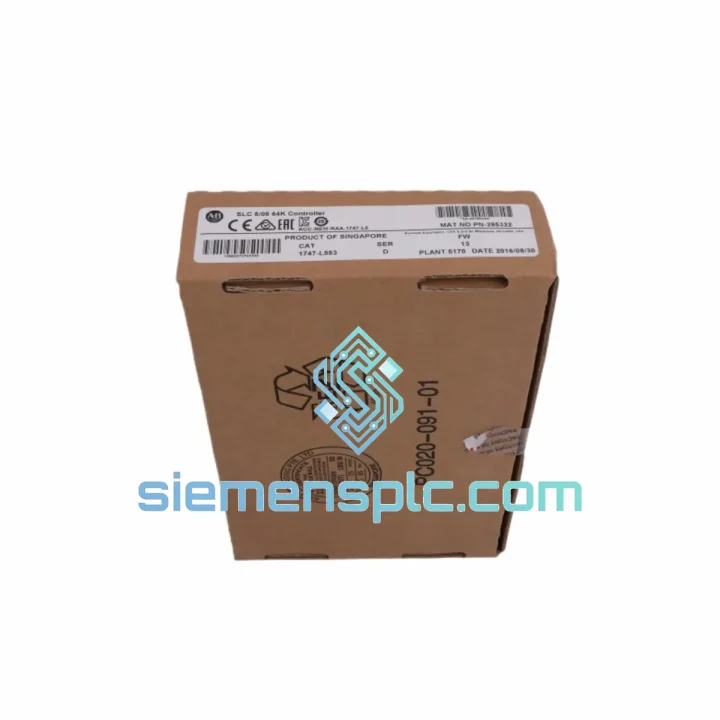
Request verified availability, condition, replacement risk review, packing options and courier lead time for 1747-L553.
Click Request Quote and the part number is inserted into the inquiry form automatically.
Core fields for model confirmation and RFQ routing. Detailed product narrative remains below.
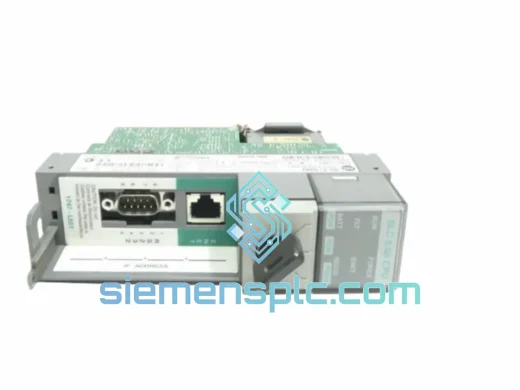
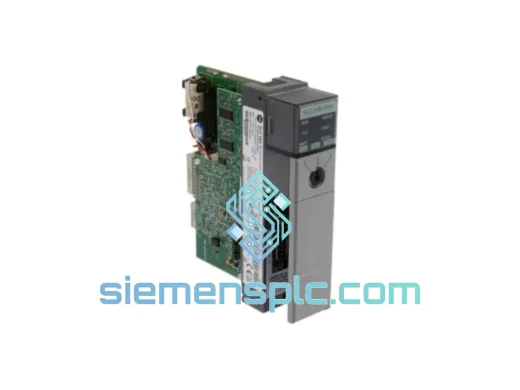
The 1747-L553 is the highest-memory variant within the SLC 5/05 processor family, occupying slot 0 of any SLC 500 modular chassis. It combines a 64K-word user program and data memory space with a native 10/100 Mbps EtherNet/IP port and a full-duplex RS-232 channel, making it the preferred CPU for mid-scale discrete and process control systems that require both plant-floor Ethernet connectivity and legacy serial network compatibility. Unlike gateway-dependent architectures, the 1747-L553 terminates EtherNet/IP messaging directly at the processor backplane, eliminating one layer of protocol translation and the associated latency budget.
Real-time Stock & RFQ: [email protected] | WhatsApp: +86 18359268345
| Part Number | 1747-L553 |
| Platform | SLC 500 / SLC 5/05 |
| Manufacturer | Allen-Bradley (Rockwell Automation) |
| User Memory | 64K Words (program + data combined) |
| Data Table Size | Up to 32K Words addressable data files |
| EtherNet/IP Port | 10/100 Mbps, auto-negotiate, RJ-45; supports MSG, PCCC, CIP I/O |
| Serial Port | RS-232 (DB-9); configurable for DH-485, DF1 Full-Duplex, DF1 Half-Duplex, ASCII |
| Max I/O Points | 4,096 discrete (local + remote via 1747-SN / 1747-ASB) |
| Max I/O Modules | 30 modules across all chassis |
| Scan Time | ≈ 1 ms per 1K of Boolean logic; floating-point math ≈ 4–8 ms/K |
| Instruction Set | Full SLC 500 ladder instruction set incl. PID, MSG, SQI/SQO, FFL/FFU |
| PID Loops | Up to 100 software PID loops (scan-time dependent) |
| Supply Voltage | Supplied by chassis power supply (1746-P2: 2A @ 5 VDC / 1746-P4: 4A @ 5 VDC) |
| Backplane Current Draw | 800 mA @ 5 VDC |
| Operating Temperature | 0 °C to +60 °C |
| Storage Temperature | −40 °C to +85 °C |
| Relative Humidity | 5 % to 95 % non-condensing |
| Vibration (Operating) | 2 g, 10–500 Hz per IEC 60068-2-6 |
| Shock | 30 g, 11 ms half-sine per IEC 60068-2-27 |
| Certifications | UL 508, CE (EN 61131-2), RoHS, C-Tick |
| Programming Software | RSLogix 500 v8.x or later; AOP available in Studio 5000 v21+ |
| Firmware Update | Field-upgradeable via ControlFlash utility |
| Weight | Approx. 450 g |
| Warranty | 12 months against manufacturing defects |
The 1747-L553 processor architecture is built around a 16-bit fixed-point execution engine with a dedicated floating-point co-processor path, allowing the CPU to handle integer ladder logic and real-number PID calculations on separate execution threads without stalling the primary scan cycle. The backplane interface uses a parallel data bus operating at 5 VDC logic levels, with the processor acting as the sole bus master. All I/O module reads and writes are arbitrated through a deterministic token-passing scheme: the CPU issues a backplane scan command at the start of each program scan, collects all input image data into the I1 file, executes the ladder program, then writes the output image from the O0 file back to output modules in a single burst. This architecture guarantees that no I/O module can inject asynchronous data into the program scan, which is a fundamental requirement for safety-adjacent control loops.
The EtherNet/IP subsystem is implemented as a co-processor with its own TCP/IP stack, sharing memory with the main CPU through a dual-port RAM interface. This design means that incoming MSG instructions or CIP I/O connections do not interrupt the ladder scan; instead, they are queued in the shared memory region and serviced between scan cycles. The practical consequence is that EtherNet/IP communication latency is bounded by the program scan time rather than by network jitter, which is a significant advantage in applications where SCADA polling must not perturb control loop timing.
EMC performance is achieved through a combination of hardware and layout measures. The processor PCB uses a four-layer stackup with dedicated ground planes separating the digital logic layer from the backplane interface layer. All external-facing signal lines — the RJ-45 Ethernet port and the DB-9 serial connector — pass through common-mode chokes and transient voltage suppression (TVS) diodes rated to IEC 61000-4-4 (EFT) Level 3 and IEC 61000-4-5 (surge) Level 2. The chassis ground connection through the DIN-rail mounting clip provides a low-impedance path for shield currents, keeping conducted emissions below EN 55011 Class A limits without requiring additional external filtering in most panel layouts.
Battery-backed SRAM retains the user program and data tables during power loss. The lithium battery (catalog 1747-BA) has a rated shelf life of approximately five years at 25 °C. A low-battery fault bit (S:2/14) is set in the status file when the battery voltage drops below threshold, allowing the application program to generate a maintenance alarm before data integrity is at risk. The processor also supports a flash memory backup: the program can be stored to internal flash via the Memory Module (1747-M13 or 1747-M15), enabling automatic program restore on power-up without operator intervention — a critical feature for unmanned remote installations.
The 1747-L553 delivers measurable advantages across eight dimensions of system design and operation:
Every 1747-L553 unit dispatched from our Xiamen, China facility is sourced directly from authorized Allen-Bradley distribution channels or verified surplus stock with full traceability. Pre-shipment inspection covers three stages: visual authentication of date codes, catalog label holograms, and PCB revision markings against Rockwell Automation factory records; functional power-on testing with backplane communication verification; and ESD-safe packaging in anti-static bags with foam-lined double-wall cartons. A certificate of conformance and functional test report are available upon request for each unit.
Logistics from Xiamen reach major industrial hubs on the following typical transit schedules: Hong Kong and Southeast Asia within 2–3 business days via air freight; Europe and North America within 5–7 business days via DHL Express or FedEx International Priority; Middle East and South Asia within 4–6 business days. All shipments include full commercial invoice documentation, HS code 8537.10 classification, and export compliance screening. For time-critical plant shutdowns, same-day dispatch is available for orders confirmed before 14:00 CST.
The 12-month warranty covers manufacturing defects and functional failures under normal operating conditions. Warranty claims are processed with a target response time of 24 hours and replacement dispatch within 3 business days of fault confirmation.
📧 Email: [email protected]
📱 WhatsApp: +86 18359268345
🌐 Web: siemensplc.com
📍 Location: Xiamen, China
© 2026 siemensplc.com. All rights reserved.
We check the full part number, brand, series and visible nameplate information before quotation.
Sales confirms stock path, condition option, quantity and realistic lead time for export dispatch.
DHL, FedEx, UPS or buyer courier arrangements can be reviewed with packing requirements.
Similar brand or category products for fast comparison and multi-item RFQ lists.