Siemens
RFQ Ready
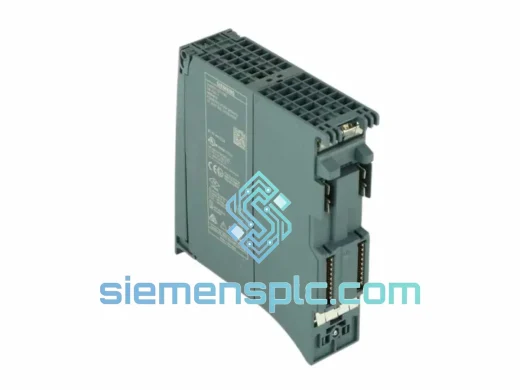
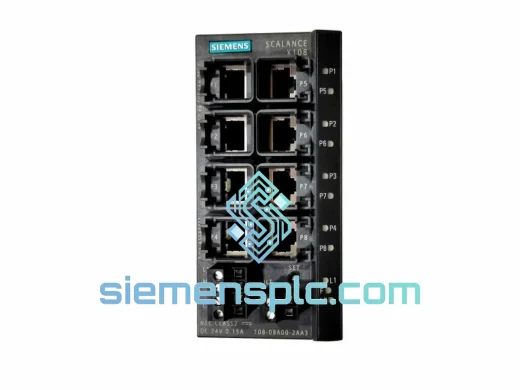
SIEMENS 6GK5108-0BA00-2AA3 Industrial Ethernet Switch
SIMATIC
Origin DE
Industrial Ethernet Switch
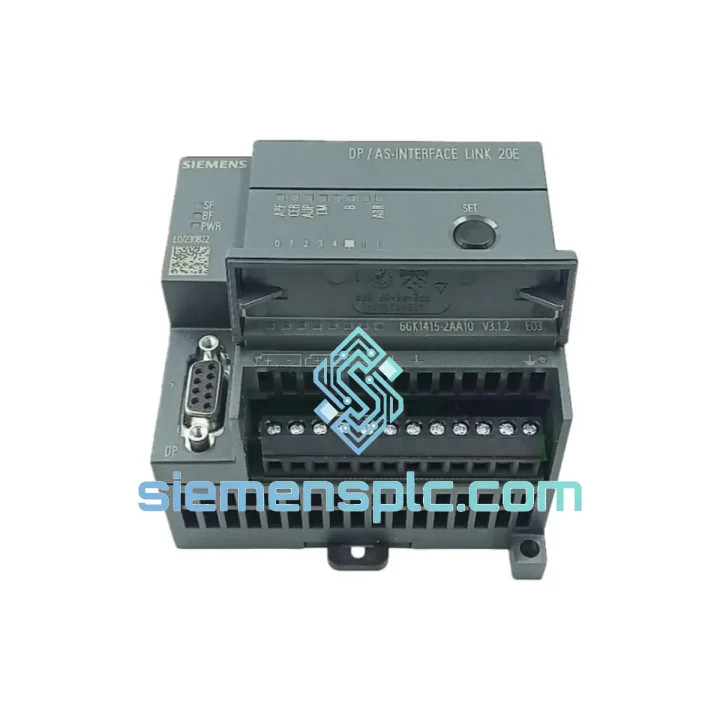
Request verified availability, condition, replacement risk review, packing options and courier lead time for 6GK1415-2AA10.
Click Request Quote and the part number is inserted into the inquiry form automatically.
Core fields for model confirmation and RFQ routing. Detailed product narrative remains below.
The 6GK1415-2AA10 occupies a structurally critical position in any SIMATIC NET fieldbus hierarchy: it terminates a PROFIBUS DP segment as a slave node while simultaneously operating as an AS-Interface master on the lower network tier. This dual-role architecture allows a single S7-300, S7-400, or S7-1500 (with CM 1243-5) controller to address up to 62 AS-i slaves — sensors, actuators, valve terminals, and indicator columns — through a single PROFIBUS DP address slot, without consuming additional DP node addresses or requiring a dedicated CPU communication processor.
The gateway handles all AS-i master protocol duties autonomously: it executes the AS-i master call sequence at a fixed cycle of ≤ 5 ms for 31 standard slaves, manages slave address assignment via the Address Programming Unit (APU) interface, and maintains the LPS (List of Projected Slaves) and LAS (List of Activated Slaves) registers independently of the PROFIBUS DP scan cycle. This decoupled execution model means that a PROFIBUS DP network operating at 1.5 Mbps with a 10 ms DP cycle does not impose jitter on the AS-i polling loop — the two cycles run asynchronously with the gateway buffering I/O data between them.
On the PROFIBUS DP side, the 6GK1415-2AA10 auto-detects baud rates from 9.6 kbps through 12 Mbps, eliminating the need for manual DIP-switch configuration of transmission speed. The module’s GSD file (SI008F10.GSD) defines the I/O data structure: 4 bits of output data and 4 bits of input data per AS-i slave are mapped into the PROFIBUS DP I/O image, with the full 31-slave configuration consuming 16 bytes of input and 16 bytes of output in the DP master’s process image. For A/B extended addressing (62 slaves), the data width doubles accordingly.
Power architecture is noteworthy: the 6GK1415-2AA10 draws its operating power directly from the AS-i bus voltage (29.5–31.6 V DC), requiring no separate 24 V DC auxiliary supply. This eliminates a wiring run and a fuse circuit in the control cabinet, reducing both BOM cost and potential failure points. The AS-i bus itself is polarity-insensitive and uses an unshielded two-wire flat cable, further simplifying field installation.
The module mounts on a standard 35 mm DIN rail with a footprint of approximately 45 × 110 × 75 mm and weighs 196 g. IP20 protection class positions it for cabinet-interior use. Operating temperature range of 0 °C to +60 °C covers the majority of industrial panel environments, while the storage range of −40 °C to +85 °C accommodates cold-chain logistics and warehouse conditions. ATEX Zone 2 certification (Group II, Category 3G) permits installation in light hazardous area panels where flammable gas concentrations are unlikely under normal operation.
Configuration is performed entirely within STEP 7 v5.x or TIA Portal v13 and above. The GSD file import procedure takes under two minutes; the module appears in the hardware catalog as a standard DP slave with configurable I/O byte assignments. No additional software license or firmware download is required for standard AS-i Specification 2.1 slave networks. Diagnostic data — including slave fault flags, configuration mismatch indicators, and AS-i power fail status — are returned to the DP master via the standard DP diagnostic telegram, making fault isolation transparent at the HMI or SCADA level without requiring a separate diagnostic tool on the AS-i segment.
Real-time Stock & RFQ: [email protected] | WhatsApp: +86 18359268345
| Parameter | Specification |
|---|---|
| Part Number (MLFB) | 6GK1415-2AA10 |
| Product Family | SIMATIC NET AS-Interface |
| Upper Interface | PROFIBUS DP (Slave, IEC 61158) |
| Lower Interface | AS-Interface Master (AS-i Spec 2.1) |
| Max. AS-i Slaves (Standard) | 31 |
| Max. AS-i Slaves (A/B Extended) | 62 |
| AS-i Master Cycle Time | ≤ 5 ms (31 slaves) |
| PROFIBUS DP Baud Rate | 9.6 kbps – 12 Mbps (auto-detect) |
| DP I/O Data Width (31 slaves) | 16 bytes IN / 16 bytes OUT |
| Supply Voltage | AS-i bus powered, 29.5–31.6 V DC |
| Current Consumption from AS-i Bus | ≤ 80 mA |
| Protection Class | IP20 |
| Operating Temperature | 0 °C to +60 °C |
| Storage Temperature | −40 °C to +85 °C |
| Relative Humidity | 5–95 % (non-condensing) |
| Mounting | 35 mm DIN rail (EN 60715) |
| Dimensions (W × H × D) | 45 × 110 × 75 mm |
| Weight | 196 g |
| Certifications | CE, UL, ATEX Zone 2 (Group II, Cat. 3G) |
| GSD File | SI008F10.GSD |
| Configuration Software | STEP 7 v5.x / TIA Portal v13+ |
| Country of Origin | Germany |
| Warranty | 12 months against manufacturing defects |
The 6GK1415-2AA10 implements a dual-processor architecture internally: one processor handles the PROFIBUS DP slave state machine — managing token passing, data exchange telegrams, and diagnostic response — while a second dedicated microcontroller executes the AS-i master call sequence. The two processors communicate via a shared dual-port RAM buffer, which decouples the timing domains of the two fieldbus protocols. This design prevents PROFIBUS DP bus latency spikes (caused by token rotation delays at high node counts) from propagating into the AS-i polling cycle, preserving the deterministic ≤ 5 ms AS-i response guarantee regardless of DP network load.
EMC hardening is implemented at multiple layers. The PCB layout uses a split ground plane with a dedicated analog ground island for the AS-i bus interface circuitry, minimizing conducted noise coupling from the digital logic domain. Transient voltage suppression (TVS) diodes rated at ±1 kV are placed at both the PROFIBUS DP connector and the AS-i bus terminals, providing protection against electrostatic discharge and inductive switching transients common in motor-drive environments. The module’s plastic housing incorporates a conductive inner coating that provides shielding continuity when mounted in a grounded metal DIN rail enclosure.
The AS-i master controller implements the full AS-i Specification 2.1 master protocol, including automatic slave detection, address conflict resolution, and the APU (Address Programming Unit) interface for field address assignment without a laptop. The LPS/LAS comparison logic runs on every AS-i master cycle: if a projected slave fails to respond within the defined timeout window (typically one missed cycle), the module sets the corresponding fault bit in the PROFIBUS DP diagnostic data and continues polling remaining slaves without halting the AS-i cycle — a non-blocking fault model that prevents a single sensor failure from freezing the entire network segment.
PROFIBUS DP baud rate auto-detection uses a hardware synchronization circuit that monitors the PROFIBUS line for valid start delimiters across the full baud rate range. Lock-on typically occurs within 3–5 DP bus cycles after power-up, after which the module enters normal data exchange mode. This eliminates the need for baud rate DIP switches and ensures the module adapts automatically if the DP master is replaced with a unit configured at a different speed.
Every 6GK1415-2AA10 unit supplied by siemensplc.com is sourced from verified Siemens-authorized distribution channels. Each unit undergoes a multi-stage incoming inspection protocol: label and date code verification against Siemens factory records, visual inspection of PCB and connector condition, and a functional power-on test confirming AS-i bus power draw within specification and PROFIBUS DP diagnostic response. Units are stored in ESD-safe anti-static packaging within a humidity-controlled warehouse environment to prevent moisture ingress and electrostatic damage during storage.
Shipments originate from Xiamen, China — a major international logistics hub with direct air freight connections to Frankfurt, Amsterdam, Chicago O’Hare, Singapore Changi, and Dubai. Standard export documentation includes a commercial invoice, packing list, and certificate of origin. For procurement teams requiring additional traceability, batch records and supplier chain documentation are available on request. Typical air freight transit times are 3–5 business days to Europe and North America, 2–3 business days to Southeast Asia, and 1–2 business days to Japan and South Korea. DHL Express, FedEx International Priority, and UPS Worldwide Express are the primary carriers, with tracking provided at shipment confirmation.
All units carry a 12-month warranty against manufacturing defects from the date of shipment. Warranty claims are processed with a replacement-first policy: a replacement unit is dispatched upon receipt of the defective module and confirmation of the fault condition. No restocking fees apply to warranty returns. For time-critical production line situations, advance replacement shipment can be arranged upon request.
Email: [email protected]
WhatsApp: +86 18359268345
Web: siemensplc.com
Location: Xiamen, China
© 2026 siemensplc.com. All rights reserved.
We check the full part number, brand, series and visible nameplate information before quotation.
Sales confirms stock path, condition option, quantity and realistic lead time for export dispatch.
DHL, FedEx, UPS or buyer courier arrangements can be reviewed with packing requirements.
Similar brand or category products for fast comparison and multi-item RFQ lists.