Mitsubishi Electric
RFQ Ready
Mitsubishi FX3U-4AD-PT-ADP Analog Input Adapter
MELSEC FX
Origin JP
PLC Analog Input Adapter
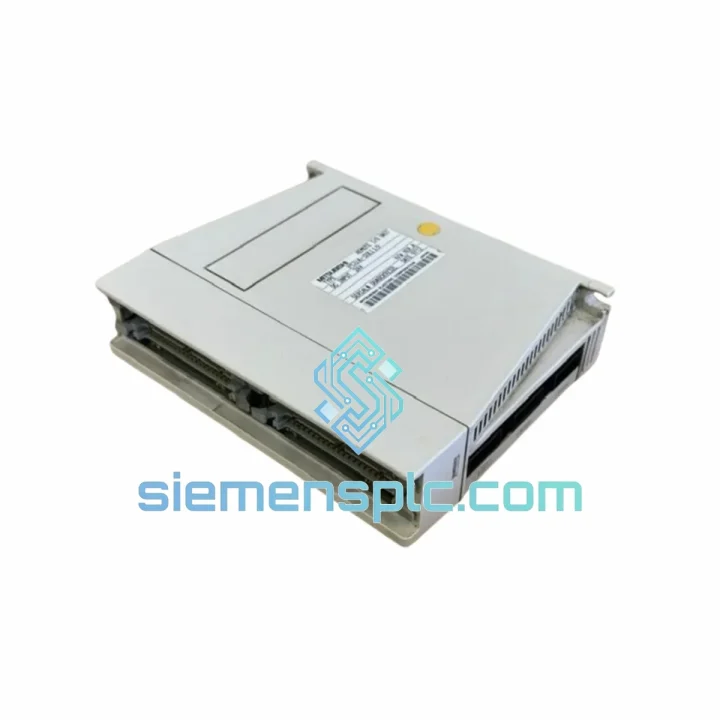
Request verified availability, condition, replacement risk review, packing options and courier lead time for FCUA-EX10.
Click Request Quote and the part number is inserted into the inquiry form automatically.
Core fields for model confirmation and RFQ routing. Detailed product narrative remains below.
The Mitsubishi Electric FCUA-EX10 is a dedicated digital I/O expansion module engineered for integration within the MELDAS CNC control platform. In multi-axis machine tool environments — vertical machining centers, horizontal boring mills, and compound turning centers — the base I/O capacity of a CNC controller is frequently insufficient to address the full signal map of auxiliary functions: tool magazine indexing, hydraulic clamping interlocks, coolant flow confirmation, door safety circuits, and axis-specific overtravel detection. The FCUA-EX10 resolves this constraint by extending the controller’s addressable I/O space through the MELDAS high-speed serial bus, maintaining deterministic signal latency across all connected channels without introducing additional scan-cycle overhead to the main CPU.
Within the FCUA-EX series architecture, the EX10 variant occupies a specific position: it provides a defined number of optically isolated digital input and output channels, each rated for 24 VDC logic levels consistent with IEC 61131-2 Type 1 and Type 3 input specifications. The optical isolation barrier between field-side wiring and the module’s internal logic bus is a fundamental design requirement in machine tool environments, where inductive loads — solenoid valves, relay coils, motor contactors — generate transient voltage spikes that can reach several hundred volts in microsecond durations. The FCUA-EX10’s isolation stage suppresses these transients before they can propagate to the CNC controller’s backplane, protecting the CPU and servo interface cards from damage that would otherwise require full system replacement.
Real-time Stock & RFQ: [email protected] | WhatsApp: +86 18359268345
| Parameter | Specification |
|---|---|
| Part Number / SKU | FCUA-EX10 |
| Manufacturer | Mitsubishi Electric Corporation |
| Series | MELDAS CNC — FCUA-EX I/O Expansion Series |
| Module Classification | Digital I/O Expansion Module |
| Signal Voltage (Field Side) | 24 VDC (IEC 61131-2 compliant) |
| Isolation Method | Optical isolation (field-to-logic bus) |
| Bus Interface | MELDAS high-speed serial I/O bus |
| Compatible Controllers | MELDAS C6, C64, M6, M64 series (verify per hardware manual) |
| Operating Temperature | 0 °C to +55 °C (storage: −20 °C to +70 °C) |
| Relative Humidity | 10% to 90% RH, non-condensing |
| Vibration Resistance | Compliant with JIS B 3502 / IEC 61131-2 vibration class |
| Country of Origin | Japan |
| Weight (as shipped) | Approx. 4,560 g |
| Warranty | 12 months from date of shipment |
The FCUA-EX10’s internal architecture reflects the design priorities of high-cycle CNC environments, where I/O response time directly influences machining accuracy and safety interlock reliability.
Optical Isolation Architecture: Each input channel incorporates a discrete optocoupler stage. The LED side of the coupler is driven by the field-side 24 VDC signal through a current-limiting resistor network, while the phototransistor side feeds directly into the module’s internal logic. This arrangement provides a minimum isolation voltage of 500 V (DC) between field wiring and the logic bus, sufficient to withstand the common-mode transients generated by solenoid valve switching in hydraulic circuits. The isolation also eliminates ground loop currents that would otherwise introduce noise into the CNC controller’s analog measurement channels.
EMC Design Compliance: The module’s PCB layout follows Mitsubishi Electric’s internal EMC design rules for industrial control hardware, including controlled impedance traces on the serial bus interface, ground plane segmentation between field-side and logic-side circuits, and ferrite bead filtering on power supply rails. These measures ensure the module meets EN 61000-4-4 (electrical fast transient/burst) and EN 61000-4-5 (surge immunity) requirements without external filtering components.
Serial Bus Arbitration: Communication between the FCUA-EX10 and the MELDAS CNC CPU occurs over a dedicated high-speed serial I/O bus. The bus protocol uses a master-slave arbitration model in which the CNC CPU initiates each scan cycle by polling connected I/O nodes in a fixed sequence. The FCUA-EX10 responds within a defined time window, ensuring that its channel data is available to the ladder logic interpreter before the next interpolation cycle begins. This architecture prevents I/O scan jitter from accumulating into axis position errors — a critical requirement in contouring operations where feed rate and position loop closure depend on deterministic I/O state updates.
Output Driver Protection: Digital output channels incorporate overcurrent protection circuitry that limits output current to a safe level in the event of a short circuit on the field wiring. The protection circuit resets automatically once the fault condition is cleared, avoiding the need for manual intervention to restore output function after a wiring fault is corrected.
Every FCUA-EX10 unit supplied by siemensplc.com is sourced through verified industrial automation supply channels and subjected to a structured pre-shipment inspection process. Visual examination covers PCB condition, connector integrity, component seating, and label authenticity against Mitsubishi Electric part marking standards. Functional verification is performed where test infrastructure permits, using reference MELDAS hardware to confirm bus communication and channel response. Units are packaged in anti-static bags within rigid foam-lined cartons, with desiccant packs included for shipments to high-humidity destinations.
Logistics operations are based in Xiamen, China, a major port city with direct access to international express freight services including DHL, FedEx, UPS, and TNT, as well as consolidated sea freight for bulk orders. Standard express delivery to destinations in Europe, North America, Southeast Asia, and the Middle East typically completes within 3 to 7 business days from the date of dispatch. Air freight with full tracking and commercial invoice documentation is provided as standard. For orders requiring export licensing documentation or specific customs declarations, our logistics team prepares the necessary paperwork to facilitate smooth customs clearance at the destination port.
All shipments are covered by a 12-month warranty from the date of shipment. Warranty claims are handled directly by our technical team; defective units are replaced or credited without requiring the customer to navigate a third-party returns process. This warranty applies to verified manufacturing defects and does not cover damage resulting from incorrect installation, overvoltage conditions beyond the module’s rated isolation level, or physical impact during installation.
Email: [email protected]
WhatsApp: +86 18359268345
Web: siemensplc.com
Location: Xiamen, China
© 2026 siemensplc.com. All rights reserved.
We check the full part number, brand, series and visible nameplate information before quotation.
Sales confirms stock path, condition option, quantity and realistic lead time for export dispatch.
DHL, FedEx, UPS or buyer courier arrangements can be reviewed with packing requirements.
Similar brand or category products for fast comparison and multi-item RFQ lists.