Bently Nevada
RFQ Ready
Bently Nevada RS901104-03-050-10-01 Proximitor Sensor – 3300 XL Series
3300 XL
Origin US
Proximitor Sensor
Request verified availability, condition, replacement risk review, packing options and courier lead time for 9200-01-05-10-00.
Click Request Quote and the part number is inserted into the inquiry form automatically.
Core fields for model confirmation and RFQ routing. Detailed product narrative remains below.
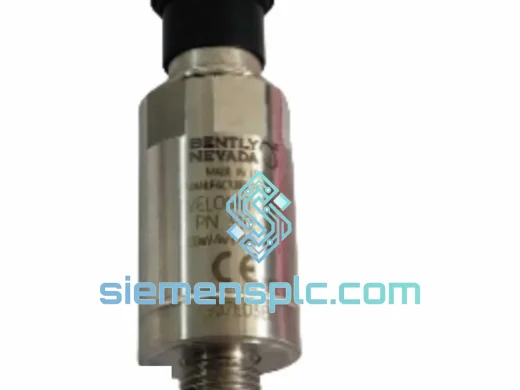
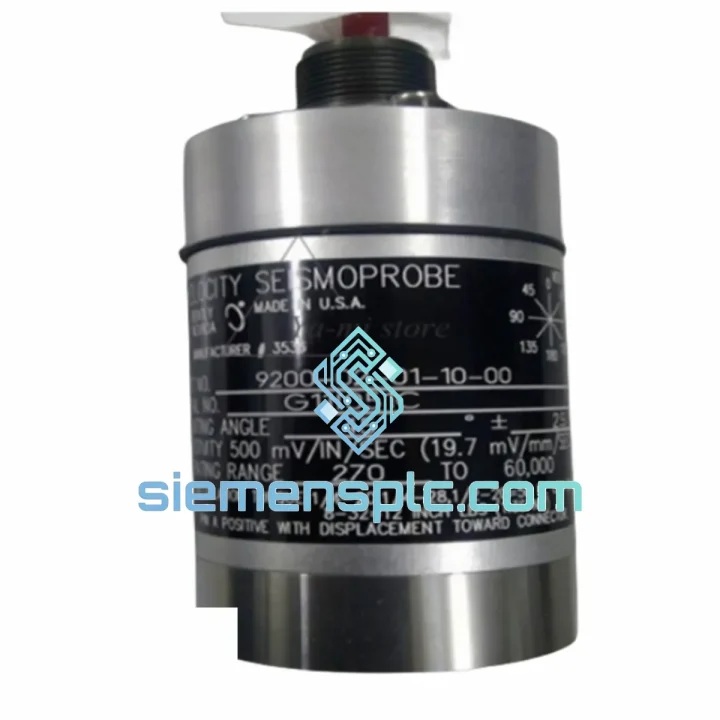
The Bently Nevada 9200-01-05-10-00 is a self-generating electromagnetic velocity transducer designed for continuous absolute vibration measurement on machine casings and bearing housings. It operates as a primary sensing element within API 670-compliant machinery protection architectures, delivering a direct analog voltage output proportional to structural velocity — without requiring any external excitation power. This characteristic makes it a mechanically and electrically straightforward component in protection loops where power supply failure modes must be minimized.
The 9200 Seismoprobe series occupies a specific and non-substitutable role in rotating equipment monitoring: it captures absolute casing motion in velocity units (in/s or mm/s), which proximity probes — measuring relative shaft displacement via eddy-current — cannot provide. In a fully instrumented turbomachinery train per API 670, both measurement types are required. The 9200-01-05-10-00 is the field-standard variant for this function, deployed across steam turbines, gas turbines, centrifugal compressors, and large rotating machinery in power generation, petrochemical, and heavy industrial facilities globally.
Real-time Stock & RFQ: [email protected] | WhatsApp: +86 18359268345
| Parameter | Specification |
|---|---|
| Part Number | 9200-01-05-10-00 |
| Manufacturer | Bently Nevada (Baker Hughes) |
| Series | 9200 Seismoprobe |
| Transducer Type | Self-Generating Electromagnetic Velocity |
| Measurement Axis | Absolute Casing / Bearing Housing Vibration |
| Sensitivity | 200 mV/in/s (7.87 mV/mm/s) nominal |
| Frequency Response | 10 – 1,000 Hz (–3 dB points) |
| Internal Resonant Frequency | ~8 Hz (spring-mass seismic element) |
| Full-Scale Velocity Range | 0 – 2 in/s pk (0 – 50.8 mm/s pk) |
| Coil DC Resistance | ~1,750 Ω (field-verifiable at connector pins) |
| Output Signal | Analog voltage, self-generated (no power supply required) |
| Connector Type | MIL-C-5015 style, 2-pin |
| Integral Cable Length | 5 ft (1.52 m), armored construction |
| Mounting Thread | 1/4-28 UNF or 1/4 NPT (configuration-dependent) |
| Mounting Orientation | Vertical or Horizontal (specified at order) |
| Operating Temperature | –40 °C to +121 °C (–40 °F to +250 °F) |
| Housing Material | 316 Stainless Steel |
| Ingress Protection | IP67 (dust-tight; immersion to 1 m for 30 min) |
| Weight | ~100 g |
| Compatible Monitor Platforms | Bently Nevada 3300 Series; 3500 Series (adapter may apply); ADRE systems |
| Standards Compliance | API 670, CE Marking |
| Warranty | 12 months from date of shipment against manufacturing defects |
The 9200-01-05-10-00 is built around a seismic spring-mass mechanism: a permanent magnet assembly suspended on a calibrated spring within a cylindrical stainless steel housing. When the housing (attached to the machine casing) accelerates, the suspended magnet lags behind due to inertia, producing relative motion between the magnet and a surrounding coil wound on the housing. By Faraday’s law, this relative velocity induces an EMF directly proportional to the instantaneous velocity of the casing — no signal conditioning, no amplifier, no power rail required at the sensing element.
Spring-Mass Resonance and Usable Bandwidth: The internal resonant frequency is approximately 8 Hz. Below this frequency, the seismic mass moves with the housing (no relative motion, no output). Above resonance, the mass remains stationary in inertial space while the housing moves around it — this is the operating regime. The usable flat response band (10–1,000 Hz at –3 dB) is determined by the spring stiffness, mass, and internal damping coefficient. The damping ratio is tuned to flatten the response through resonance and extend the low-frequency usable range without excessive phase error.
EMC and Signal Integrity: The self-generating output is a low-impedance voltage source (~1,750 Ω source impedance), which provides inherent noise immunity compared to high-impedance charge-mode accelerometers. The armored integral cable provides mechanical protection and electrostatic shielding. For installations near variable-frequency drives (VFDs) or high-current bus bars, single-point shield grounding at the monitor end is mandatory to prevent common-mode noise injection into the measurement loop.
316 SS Housing and Hermetic Sealing: The 316 stainless steel housing resists chloride-induced stress corrosion cracking — a relevant failure mode in offshore, coastal, and chemical plant environments. The IP67 rating confirms the internal mechanism is sealed against dust ingress and short-term immersion, protecting the spring-mass assembly and coil from humidity-induced corrosion over multi-year service intervals.
Mounting Mechanics: The 1/4-28 UNF or 1/4 NPT mounting thread provides a rigid, low-compliance mechanical coupling to the machine structure. Mounting compliance (soft mounts, adhesive pads) introduces a secondary spring-mass system that distorts the frequency response and must be avoided in precision monitoring applications. Recommended mounting torque is 15–20 in-lb (1.7–2.3 N·m); over-torquing risks deforming the housing and altering the internal spring preload.
Every Bently Nevada 9200-01-05-10-00 unit dispatched from our Xiamen, China facility is sourced through verified distribution channels with full OEM traceability. Incoming inspection covers visual examination of housing and connector integrity, dimensional verification of mounting thread, coil DC resistance measurement (acceptance criterion: 1,750 Ω ±10%), and cable continuity check. Units failing any inspection criterion are quarantined and not dispatched.
Documentation available upon request includes the original Bently Nevada datasheet, Certificate of Conformance (CoC), and incoming inspection test record — standard requirements for nuclear, offshore, and power generation procurement packages. All inventory is stored in a climate-controlled, ESD-safe warehouse environment with shelf-life tracking per manufacturer storage guidelines.
Serial numbers are cross-referenced against manufacturer records as part of anti-counterfeit verification. Packaging integrity and holographic label authenticity are confirmed on every unit prior to dispatch. A 12-month warranty against manufacturing defects is provided from the date of shipment.
Logistics: Orders are dispatched from Xiamen, China via DHL Express, FedEx International Priority, or customer-nominated freight forwarder. Standard dispatch lead time is 3–5 business days for in-stock units. Export documentation — commercial invoice, packing list, certificate of origin, and HS code classification — is prepared by our logistics team. Expedited dispatch for critical shutdowns is available upon request. Worldwide delivery coverage includes North America, Europe, Middle East, Southeast Asia, and Australia.
Email: [email protected]
WhatsApp: +86 18359268345
Web: siemensplc.com
Location: Xiamen, China
© 2026 siemensplc.com. All rights reserved.
We check the full part number, brand, series and visible nameplate information before quotation.
Sales confirms stock path, condition option, quantity and realistic lead time for export dispatch.
DHL, FedEx, UPS or buyer courier arrangements can be reviewed with packing requirements.
Similar brand or category products for fast comparison and multi-item RFQ lists.