ABB
RFQ Ready
ABB SDCS-CON-2B 3ADT309600R0012 DC Drive Control Board
DCS Series
Origin SE
DC Drive Control Board
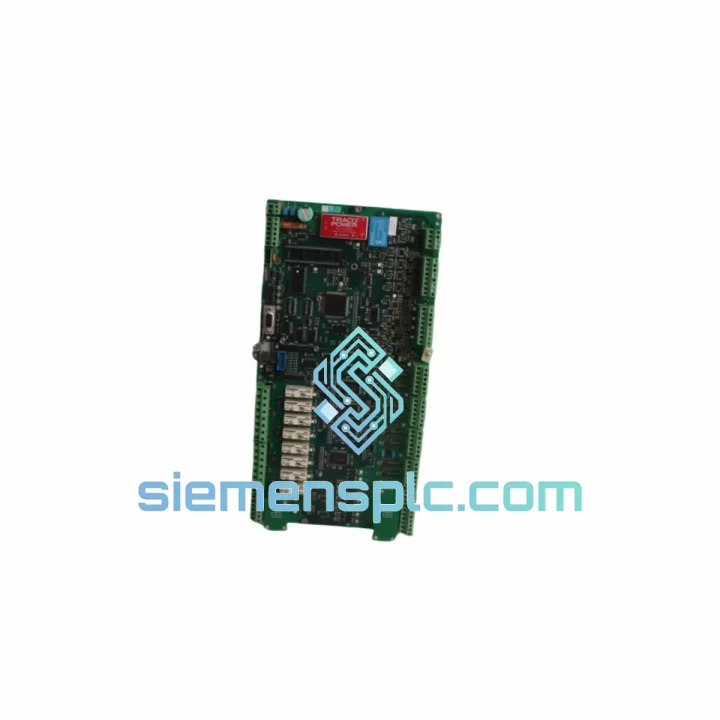
Request verified availability, condition, replacement risk review, packing options and courier lead time for DATX111 3ASC25H224.
Click Request Quote and the part number is inserted into the inquiry form automatically.
Core fields for model confirmation and RFQ routing. Detailed product narrative remains below.
The ABB DATX111, referenced under part number 3ASC25H224, is a dedicated thyristor gate firing and drive control board designed for integration within ABB’s DCS400, DCS500, and DCS600 series DC drive cabinets. Its primary function is the generation of precisely timed, phase-synchronized gate pulses for the thyristor bridge stack, translating closed-loop speed and torque commands from the main control processor into deterministic firing angles across the full AC supply cycle. Without accurate firing angle control, a thyristor-based DC drive cannot maintain stable armature voltage regulation; the DATX111 is the hardware layer that makes this regulation possible at the microsecond level.
In a typical DCS500 or DCS600 drive architecture, the DATX111 sits between the main control board (e.g., SDCS-CON-2 or SDCS-CON-4) and the thyristor stack assembly. It receives firing angle commands via the internal drive bus, synchronizes to the AC supply frequency using zero-crossing detection circuitry, and outputs isolated gate pulses to each thyristor in the bridge. This sequence must complete within a single half-cycle of the supply frequency — approximately 10 ms at 50 Hz — making the board’s internal timing logic a critical determinant of drive dynamic response.
📧 Real-time Stock & RFQ: [email protected] | WhatsApp: +86 18359268345
| Parameter | Specification |
|---|---|
| Manufacturer | ABB (Asea Brown Boveri) |
| Part Number | DATX111 |
| Reference / Order Code | 3ASC25H224 |
| Product Series | DATX / DCS Thyristor Drive Platform |
| Module Classification | Thyristor Gate Firing Card / Drive Control Board |
| Compatible Drive Platforms | ABB DCS400, DCS500, DCS600 Series |
| Supply Frequency Synchronization | 50 Hz / 60 Hz (auto-detect via zero-crossing circuit) |
| Gate Pulse Output Channels | 6 channels (3-phase fully-controlled bridge) |
| Pulse Isolation Method | Opto-coupler galvanic isolation per channel |
| Control Interface | Internal drive backplane bus (proprietary ABB DDCS-compatible) |
| PCB Surface Treatment | Conformal coating (acrylic-based, IPC-CC-830 class) |
| Operating Temperature | 0 °C to +55 °C (ambient, forced-air cooled cabinet) |
| Storage Temperature | -40 °C to +70 °C |
| Relative Humidity | 5% to 95% RH, non-condensing |
| PCB Form Factor | Rack-mount card, DIN-rail compatible bracket available |
| Approximate Weight | 800 g |
| Condition Available | New OEM / Tested Refurbished (specify at inquiry) |
| Warranty | 12 months against manufacturing defects; DOA replacement within 7 days |
| Country of Origin | Germany |
Zero-Crossing Detection and Phase Synchronization: The DATX111 employs a dedicated zero-crossing detection front-end that monitors all three phases of the AC supply. Each zero-crossing event resets the internal phase counter, allowing the firing angle computation logic to maintain synchronization even under supply frequency deviations of ±2 Hz. This is particularly relevant in island-mode power systems — common in marine and offshore installations — where grid frequency is not tightly regulated. The synchronization circuit uses hardware comparators rather than software polling, eliminating interrupt latency from the timing chain.
Opto-Coupler Galvanic Isolation Architecture: Each of the six gate pulse output channels is isolated via a dedicated high-speed opto-coupler. This architecture ensures that fault currents in the thyristor stack — which can reach several kiloamperes during commutation failures — do not propagate back into the low-voltage control logic. The isolation barrier is rated to withstand transient voltages consistent with IEC 60664-1 overvoltage category III environments, appropriate for direct connection to industrial power distribution systems.
EMC Design and Conformal Coating: The PCB layout follows a strict ground plane partitioning strategy: analog timing circuits, digital logic, and gate drive outputs occupy separate copper pour zones with controlled impedance interconnects. The conformal acrylic coating provides protection against condensation, industrial particulate contamination, and corrosive atmospheres encountered in chemical plant and paper mill environments. This coating does not impede heat dissipation from power components, which are positioned over thermal vias connected to the board’s copper ground plane.
Firing Angle Resolution and Linearity: The internal timing counter operates at a clock frequency sufficient to resolve firing angles to sub-degree accuracy across the 0°–180° controllable range. This resolution directly determines the minimum speed step achievable in open-loop voltage control mode and the torque ripple floor in closed-loop current control. For applications such as paper winder tension control, where speed regulation tighter than 0.1% is required, this hardware resolution is a prerequisite — software interpolation cannot compensate for coarse hardware timing granularity.
Redundancy Arbitration Logic: In dual-drive redundant configurations used in critical process lines, the DATX111 supports a standby-ready state where the board remains synchronized to the AC supply but holds gate pulses inhibited. On a switchover command from the supervisory control system, the board transitions from inhibited to active firing within one supply half-cycle, minimizing the torque interruption to the driven load. This behavior is governed by hardware logic rather than firmware, ensuring deterministic switchover timing independent of processor load.
Every DATX111 3ASC25H224 unit dispatched from our Xiamen facility undergoes a structured pre-shipment verification process. Power-on functional testing confirms gate pulse output on all six channels under simulated load conditions. Serial number and date code are recorded against the shipment documentation, providing full traceability for warranty claims and regulatory audits. Units sourced as new OEM stock are supplied with original ABB packaging and, where available, the manufacturer’s certificate of conformity.
Refurbished units are processed through a defined reconditioning workflow: visual inspection for PCB damage, electrolytic capacitor ESR measurement, opto-coupler forward voltage verification, and a 48-hour burn-in cycle under thermal cycling conditions. Only units passing all checkpoints are released for sale. Condition is disclosed explicitly at the time of order confirmation — no ambiguity between new and refurbished stock.
Packaging for international transit uses ESD-safe anti-static bags with humidity indicator cards, enclosed in foam-lined double-wall corrugated cartons. This packaging specification meets ISTA 2A transit testing requirements for fragile electronic assemblies. Shipments are dispatched via DHL Express, FedEx International Priority, or UPS Worldwide Express, with full tracking provided at the time of dispatch. Typical transit time from Xiamen to major industrial hubs in Europe, North America, and Southeast Asia is 3–5 business days. Export documentation including commercial invoice, packing list, and HS code declaration (8537.10) is prepared for each shipment to facilitate customs clearance.
A 12-month warranty covers manufacturing defects and functional failures under normal operating conditions. Dead-on-arrival units are eligible for replacement within 7 days of confirmed receipt. Warranty claims are processed with a target response time of one business day.
📧 Email: [email protected]
📱 WhatsApp: +86 18359268345
🌐 Web: siemensplc.com
📍 Location: Xiamen, China
© 2026 siemensplc.com. All rights reserved.
We check the full part number, brand, series and visible nameplate information before quotation.
Sales confirms stock path, condition option, quantity and realistic lead time for export dispatch.
DHL, FedEx, UPS or buyer courier arrangements can be reviewed with packing requirements.
Similar brand or category products for fast comparison and multi-item RFQ lists.