Bently Nevada
RFQ Ready
Bently Nevada RS901104-03-050-10-01 Proximitor Sensor – 3300 XL Series
3300 XL
Origin US
Proximitor Sensor
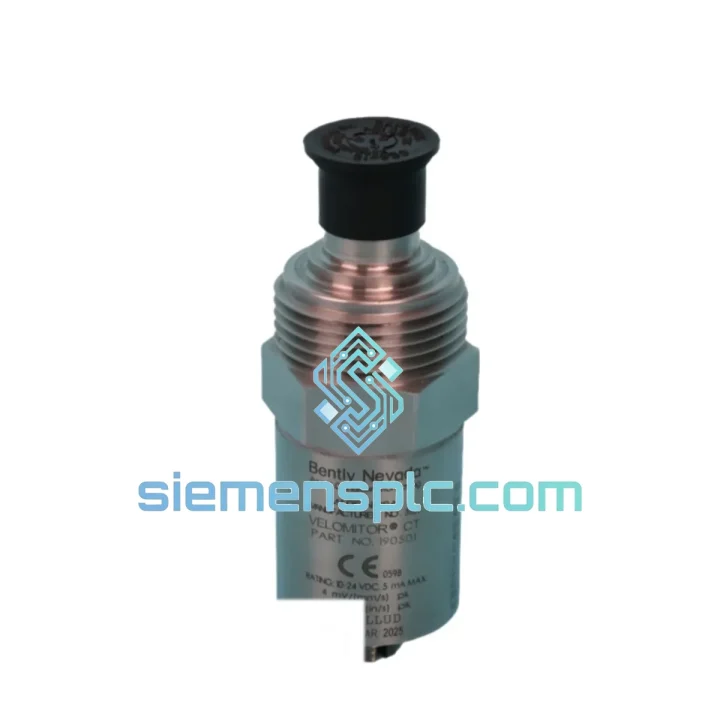
Request verified availability, condition, replacement risk review, packing options and courier lead time for 190501-11-00-00.
Click Request Quote and the part number is inserted into the inquiry form automatically.
Core fields for model confirmation and RFQ routing. Detailed product narrative remains below.
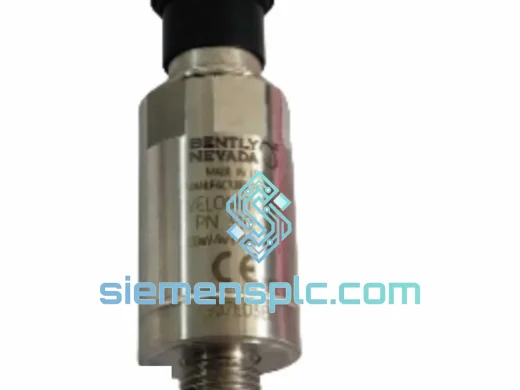
The Bently Nevada 190501-11-00-00 is a piezoelectric seismic velocity transducer within the Velomitor CT product family, engineered for continuous absolute casing vibration measurement on rotating machinery subject to API 670 protection requirements. Its operational domain covers steam turbines, centrifugal and axial compressors, cooling tower fan drives, and large-frame induction motors — machinery classes where bearing housing absolute velocity is the governing diagnostic parameter rather than shaft relative displacement.
The transducer generates a low-impedance analog voltage output proportional to casing velocity without requiring an external signal conditioner. An internal IEPE (Integrated Electronics Piezo-Electric) circuit, biased by a constant-current supply from the connected monitor input card, converts the piezoelectric crystal charge into a conditioned AC voltage superimposed on a stable DC bias. This two-wire architecture reduces field wiring to a single shielded twisted pair per measurement point, directly lowering installation material cost and junction box count in multi-channel protection rack deployments.
Compatibility is native with the Bently Nevada 3500/42M Velocity Input Module and the 3300 Series monitor platform. No impedance-matching adapters or external signal conditioners are required. The monitor’s channel OK circuitry continuously evaluates the transducer’s DC bias voltage; a deviation outside the nominal 10–12 V window immediately asserts a Not OK (NOK) status, providing automated transducer health surveillance without scheduled manual verification intervals.
Real-time Stock & RFQ: [email protected] | WhatsApp: +86 18359268345
| Parameter | Specification |
|---|---|
| Part Number | 190501-11-00-00 |
| Manufacturer | Bently Nevada (Baker Hughes) |
| Product Family | Velomitor CT |
| Transducer Technology | Shear-mode piezoelectric, IEPE signal conditioning |
| Measurement Quantity | Absolute casing vibration velocity |
| Sensitivity | 100 mV/(in/s) [3.937 mV/(mm/s)] |
| Frequency Response (±3 dB) | 4.5 Hz – 1,000 Hz |
| Full-Scale Output | ±5 V peak (AC, superimposed on DC bias) |
| DC Bias Voltage (quiescent) | ~10.5 V DC |
| Constant Current Supply | 2–10 mA (from monitor input card) |
| Supply Voltage Range | 18–30 V DC |
| Output Impedance | <100 Ω |
| Transverse Sensitivity | <5% of primary axis sensitivity |
| Operating Temperature | −40 °C to +121 °C (−40 °F to +250 °F) |
| Storage Temperature | −55 °C to +150 °C |
| Shock Survival | 500 g, 11 ms half-sine pulse |
| Vibration Survival | 20 g RMS, 20–2,000 Hz |
| Housing Material | 316L Stainless Steel, hermetically sealed |
| Ingress Protection | IP67 per IEC 60529 |
| Electrical Connector | 2-pin MIL-C-5015 bayonet-lock |
| Mounting Thread | 1/4-28 UNF (suffix-dependent) |
| Approximate Mass | 300 g (sensor body, without cable) |
| Regulatory Compliance | CE Marking; RoHS 2011/65/EU |
| Warranty | 12 months against manufacturing defects |
The sensing element in the 190501-11-00-00 is a shear-mode piezoelectric crystal stack rather than a compression-mode configuration. In a shear-mode geometry, the crystal is loaded in shear by the inertial mass when the housing accelerates; this arrangement decouples the sensing axis from base bending strains and thermally induced housing deformation. On bearing housings subject to differential thermal expansion during turbine startup ramps — where housing temperature can rise 80–100 °C over 20–30 minutes — this mechanical isolation prevents thermally generated spurious output from corrupting the vibration signal and triggering false alarms during the critical run-up phase.
The IEPE signal conditioning circuit employs a JFET-input operational amplifier stage with a carefully selected feedback network that sets the lower −3 dB corner at 4.5 Hz. This frequency is determined by the RC time constant formed by the internal coupling capacitor and the amplifier’s input bias network. Achieving 4.5 Hz with acceptable phase error requires a coupling capacitor in the range of several hundred microfarads, which the Velomitor CT accommodates within its sealed housing — a non-trivial packaging constraint that distinguishes it from lower-cost alternatives with higher low-frequency cutoffs. The practical consequence is the ability to resolve sub-synchronous vibration components: oil whirl instability in fluid-film bearings typically manifests at 0.43–0.48× running speed, which for a 1,500 RPM machine corresponds to 10.75–12 Hz — well within the transducer’s flat response band.
The 316L stainless steel housing functions as a continuous Faraday enclosure around the crystal stack and conditioning electronics. The MIL-C-5015 bayonet connector maintains 360° shield continuity at the cable interface, eliminating the shield gap that occurs with standard threaded connectors when the mating halves are partially engaged. In plant environments where variable-frequency drives generate conducted and radiated interference across the 2–150 kHz spectrum, this unbroken shield path is the primary defense against capacitively coupled noise that would otherwise appear as broadband noise floor elevation in the velocity spectrum, masking low-amplitude bearing defect sidebands.
The upper frequency limit of 1,000 Hz provides coverage to the 16th harmonic of a 3,600 RPM (60 Hz) machine and to the 40th harmonic of a 1,500 RPM (25 Hz) machine. This bandwidth is sufficient to capture blade-pass frequencies on compressors with up to 16 impeller vanes at full speed, and gear-mesh fundamentals on single-stage gearboxes with up to 16 teeth on the high-speed pinion. For machinery with higher-order excitation sources, the 190501-11-00-00 is correctly paired with a high-frequency accelerometer on the same bearing housing to provide complementary spectral coverage above 1 kHz.
All 190501-11-00-00 units supplied through siemensplc.com are procured through verified industrial distribution channels with documented supply chain traceability to the original manufacturer. Pre-shipment inspection covers label and serial number authenticity, housing surface integrity, connector pin geometry and retention force, and four-wire electrical continuity across signal, shield, and supply conductors. Units failing any inspection criterion are quarantined and not dispatched.
A 12-month warranty against manufacturing defects applies to all units. Warranty claims are processed with a target response time of 48 business hours from receipt of the defective unit. Replacement units are dispatched from Xiamen stock; no return-to-manufacturer authorization delays apply for units within the warranty period.
Export operations are based in Xiamen, Fujian Province, China — a designated free-trade zone port with direct air freight access via Xiamen Gaoqi International Airport (XMN) and sea freight access through Xiamen Port, one of the top-ten container ports in China by throughput volume. Standard export documentation (commercial invoice, packing list, certificate of origin, airway bill) is prepared for every international shipment. Certificates of Conformance and material traceability reports are available upon request at order placement. Typical in-stock dispatch lead time is 1–3 business days. Air freight transit to primary industrial destinations — Houston (IAH), Rotterdam (AMS), Singapore (SIN), Dubai (DXB) — achieves door-to-door delivery within 5–8 business days under standard service. Expedited freight options with 2–3 day transit are available for project-critical requirements; contact the sales team with the required delivery date for a freight plan and cost estimate.
Email: [email protected]
WhatsApp: +86 18359268345
Web: siemensplc.com
Location: Xiamen, China
© 2026 siemensplc.com. All rights reserved.
We check the full part number, brand, series and visible nameplate information before quotation.
Sales confirms stock path, condition option, quantity and realistic lead time for export dispatch.
DHL, FedEx, UPS or buyer courier arrangements can be reviewed with packing requirements.
Similar brand or category products for fast comparison and multi-item RFQ lists.