GE
RFQ Ready
GE IS200TRLYH1BED Relay Terminal Board – Mark VI Series
Mark VI
Origin US
Relay Terminal Board
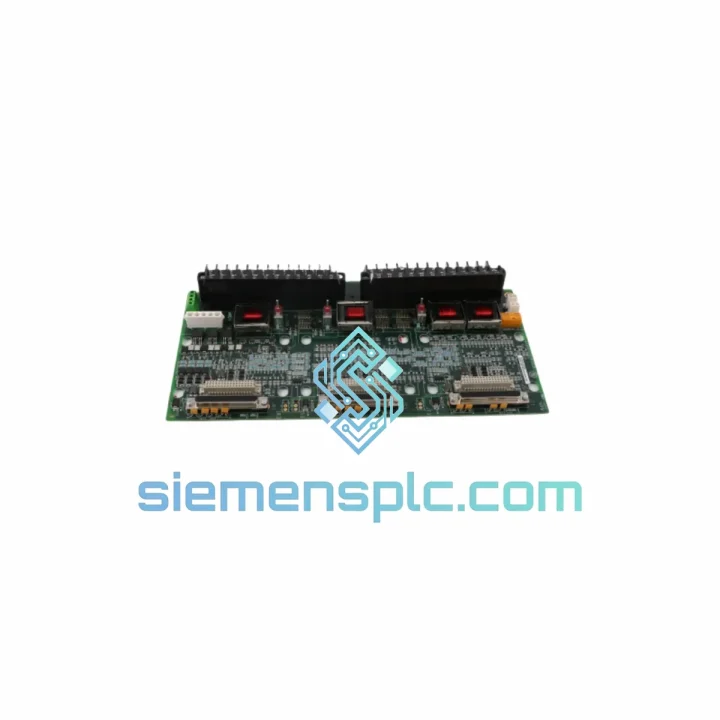
Request verified availability, condition, replacement risk review, packing options and courier lead time for IS200TSVCH1ACB.
Click Request Quote and the part number is inserted into the inquiry form automatically.
Core fields for model confirmation and RFQ routing. Detailed product narrative remains below.
A failed IS200TSVCH1ACB doesn’t give you a warning window. One moment your Mark VI DCS is reading vibration data from the proximity probes; the next, the supervisory channel drops, the controller goes blind on shaft displacement, and your protection logic trips the unit. In a combined-cycle plant running at full load, that unplanned trip can cost $50,000–$150,000 per day in lost generation revenue — before you even factor in the emergency maintenance labor. The board sitting on your shelf right now is the difference between a 4-hour swap and a 4-day sourcing nightmare.
We stock IS200TSVCH1ACB at our Xiamen warehouse. Verified original GE hardware, not grey-market pulls. DHL/FedEx express dispatch same business day on confirmed orders. If your turbine is down, stop reading and contact us now.
URGENT REQUIREMENT? Contact: [email protected] | WhatsApp: +86 18359268345
| Parameter | Value |
|---|---|
| Part Number | IS200TSVCH1ACB |
| Manufacturer | GE (General Electric / GE Vernova) |
| Series | Mark VI Turbine Control System |
| Board Function | Turbine Supervisory Vibration Control Hardware (TSVCH) |
| Form Factor | VME-bus plug-in I/O board |
| Signal Inputs | Proximity probes (Bently Nevada compatible), accelerometers, speed sensors |
| Compatible Platform | GE Mark VI / Mark VIe (verify I/O architecture before ordering) |
| Redundancy Support | TMR (Triple Modular Redundancy) and Simplex configurations |
| Hardware Revision | ACB (confirm against your existing board label) |
| Operating Temperature | 0°C to +60°C (board-level); rack environment per GE Mark VI spec |
| Weight | 880 g (approx.) |
| Condition | New surplus / Tested refurbished — 100% original GE |
| Stock Status | ✔ Ready to Ship — Xiamen Warehouse |
| Lead Time | Same-day dispatch on confirmed orders before 15:00 CST |
Common failure signatures for IS200TSVCH1ACB:
Replacement procedure — field checklist:
The IS200TSVCH1ACB was engineered for the inside of a gas turbine control enclosure — not a climate-controlled server room. GE designed the Mark VI I/O boards to operate continuously in environments that would destroy commercial-grade electronics within weeks.
The board’s PCB uses conformal coating on critical analog sections to resist moisture ingress and condensation cycles common in coastal power plants and offshore platforms. The VME connector system uses gold-plated contacts rated for thousands of insertion cycles, maintaining reliable signal integrity even after repeated maintenance interventions. Onboard voltage regulators are rated for wide input voltage tolerance, protecting the analog front-end from the power supply transients that occur during turbine start sequences.
Vibration tolerance is a non-negotiable requirement for any component mounted in a turbine control enclosure. The Mark VI rack assembly is designed to meet IEC 60068-2-6 vibration test standards, and the IS200TSVCH1ACB’s component mounting and PCB layout reflect this — surface-mount components with reinforced solder joints, no through-hole electrolytic capacitors in high-stress positions, and a board stiffener design that prevents resonance at typical turbine running frequencies (50/60 Hz and harmonics).
In high-ambient-temperature installations — gas turbine enclosures in the Middle East, for example, where ambient temperatures regularly exceed 45°C — the Mark VI rack’s forced-air cooling system is the primary thermal management mechanism. The IS200TSVCH1ACB’s power dissipation is low enough that it operates well within thermal margins even with degraded cooling airflow, giving you a buffer during filter maintenance intervals.
Our dispatch hub is in Xiamen, China — one of the most logistics-connected export cities in Asia, with direct DHL and FedEx service center access and daily flight connections to major international hubs including Hong Kong, Singapore, Dubai, Frankfurt, and Los Angeles.
Standard express timeline from Xiamen:
Every shipment includes full commercial invoice, packing list, and country-of-origin documentation. For customers in countries with import duty exemptions on industrial automation components, we can provide HS code documentation (HS 8537.10 or 8543.70 as applicable) to support customs clearance. ESD-safe inner packaging, foam-lined outer carton, and fragile handling labels are standard — no additional charge.
For genuine plant-down emergencies, contact us via WhatsApp for real-time coordination. We can arrange Saturday dispatch and after-hours pickup with DHL on a case-by-case basis for critical shutdowns.
Email: [email protected]
WhatsApp: +86 18359268345
Web: siemensplc.com
© 2026 siemensplc.com. All rights reserved.
We check the full part number, brand, series and visible nameplate information before quotation.
Sales confirms stock path, condition option, quantity and realistic lead time for export dispatch.
DHL, FedEx, UPS or buyer courier arrangements can be reviewed with packing requirements.
Similar brand or category products for fast comparison and multi-item RFQ lists.