Siemens
RFQ Ready
Siemens 6AV7240-0HC07-0PA0 Industrial Panel PC Motherboard – SIMATIC IPC477D
SIMATIC
Origin DE
Industrial Panel PC Motherboard
Request verified availability, condition, replacement risk review, packing options and courier lead time for 6AV6641-0CA01-0AX1.
Click Request Quote and the part number is inserted into the inquiry form automatically.
Core fields for model confirmation and RFQ routing. Detailed product narrative remains below.
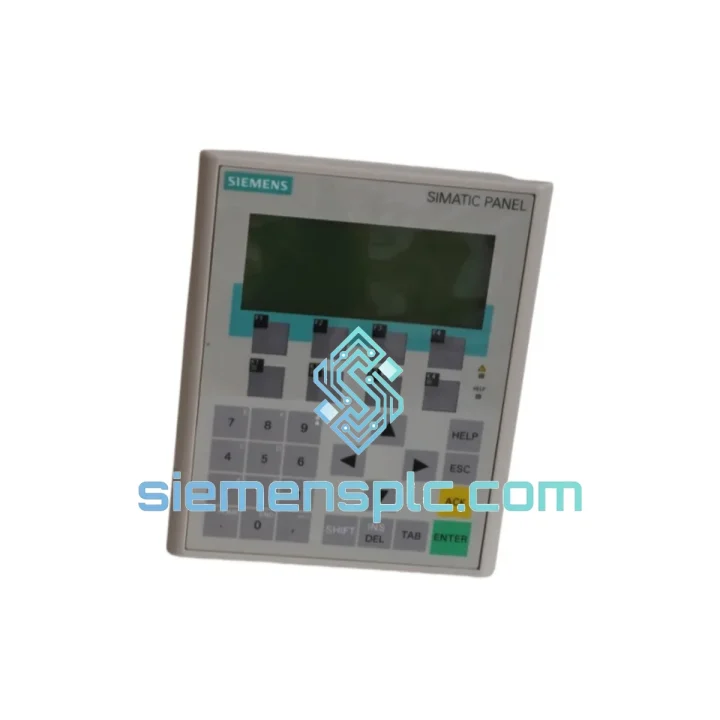
The Siemens 6AV6641-0CA01-0AX1 is a compact, keypad-operated text display panel from the SIMATIC OP 77B series, engineered for direct integration into S7-200, S7-300, and S7-400 control architectures via native MPI or PROFIBUS DP bus interfaces. Unlike graphical touch panels that introduce variable scan-cycle latency through capacitive input processing, the OP 77B employs a membrane keypad matrix with deterministic key-scan polling, delivering sub-10 ms operator input acknowledgment under full bus load conditions. This characteristic makes it the preferred HMI node in time-critical process loops where operator command latency must be bounded and predictable — such as batch sequencing, pump station interlocking, and conveyor speed override stations.
The panel’s 4-line backlit LC display operates at a character matrix resolution of 20 characters × 4 lines, driven by an HD44780-compatible controller with hardware-level contrast stabilization across the rated operating temperature range of 0 °C to +50 °C. The backlight assembly uses a cold-cathode fluorescent lamp (CCFL) circuit with regulated current drive, maintaining consistent luminance without the PWM flicker artifacts that affect some LED-backlit alternatives in low-light industrial environments. Front-panel protection is rated IP65 per IEC 60529, with a polyester membrane overlay providing resistance to mineral oils, weak acids, and alkaline cleaning agents commonly encountered in food processing and chemical plant environments.
Communication is handled by a dual-port physical layer supporting both MPI (up to 187.5 kbit/s) and PROFIBUS DP (up to 12 Mbit/s). The panel operates as a PROFIBUS DP slave or MPI node without requiring an external gateway or protocol converter, reducing BOM cost and eliminating an additional failure point in the communication chain. The integrated RS-485 transceiver is galvanically isolated from the panel’s internal logic supply, providing 500 V AC isolation between the fieldbus segment and the HMI electronics — a critical design feature in installations where ground potential differences between cabinet sections can induce common-mode noise on the bus.
Configuration is performed exclusively through WinCC flexible 2008 SP3 or later, with project data downloaded via the MPI port using a standard PC adapter (e.g., 6ES7972-0CB20-0XA0). The panel stores up to 500 process tags, 200 alarm messages, and 50 screens in its onboard flash memory, with no battery-backed RAM dependency — eliminating the maintenance overhead associated with buffer battery replacement cycles in long-lifecycle installations.
📧 Real-time Stock & RFQ: [email protected] | WhatsApp: +86 18359268345
| Parameter | Specification |
|---|---|
| Part Number | 6AV6641-0CA01-0AX1 |
| Series | SIMATIC OP 77B |
| Display Type | LC text display, CCFL backlit, 20 × 4 characters |
| Supply Voltage | 24 V DC (±20%), SELV circuit |
| Power Consumption | Approx. 4.5 W typical at 24 V DC |
| Communication Interfaces | MPI (up to 187.5 kbit/s) / PROFIBUS DP (up to 12 Mbit/s) |
| Bus Isolation | 500 V AC galvanic isolation, RS-485 transceiver |
| Keypad | Membrane keypad, 23 keys, hardware-polled scan matrix |
| Onboard Memory | Flash-based; 500 tags, 200 alarms, 50 screens |
| Front Protection Rating | IP65 per IEC 60529 |
| Operating Temperature | 0 °C to +50 °C |
| Storage Temperature | −20 °C to +70 °C |
| Relative Humidity | 10% to 90%, non-condensing |
| Panel Cutout Dimensions | 138 × 102 mm (W × H) |
| Overall Dimensions | 144 × 108 × 45 mm (W × H × D) |
| Weight | Approx. 0.5 kg |
| Mounting | Panel mounting, snap-in clips (included) |
| Compatible Engineering Tool | WinCC flexible 2008 SP3 or later |
| Compatible PLCs | SIMATIC S7-200, S7-300, S7-400, S7-1200 (via MPI adapter) |
| CE / EMC Compliance | EN 61000-6-2 (immunity), EN 61000-6-4 (emission) |
| Country of Origin | Germany |
| Warranty | 12 months from shipment date |
The OP 77B’s hardware architecture reflects a design philosophy centered on determinism and long-term field reliability rather than feature density. Several engineering decisions distinguish it from generic text panels in the same form factor class:
Galvanic Bus Isolation Architecture: The RS-485 physical layer is separated from the panel’s 3.3 V logic domain by a DC/DC converter and optocoupler barrier rated at 500 V AC continuous isolation. This is not a transient suppression measure — it is a structural isolation that prevents ground loop currents from the PROFIBUS cable shield from coupling into the display controller’s reference plane. In installations where the HMI cabinet and the PLC rack share different PE bonding points (common in large-footprint plants), this isolation prevents the systematic bit-error accumulation that degrades unprotected RS-485 links over time.
EMC Hardening: The panel’s PCB layout routes the MPI/PROFIBUS signal traces through a dedicated ground plane layer, with ferrite bead filtering on the 24 V DC input line. The metal rear housing acts as a Faraday enclosure for the logic board, attenuating radiated emissions and providing a low-impedance return path for ESD events at the keypad membrane. Compliance with EN 61000-6-2 Level 3 immunity covers 10 V/m radiated field strength — adequate for proximity to variable-frequency drives and contactor banks without additional shielding.
Flash Memory Architecture (No Battery Dependency): Project data, alarm history, and recipe values are stored in NOR flash with wear-leveling firmware. Unlike SRAM-backed designs that require periodic battery replacement (typically every 3–5 years), the OP 77B retains all configuration data through power cycles indefinitely without maintenance intervention. This is a meaningful operational advantage in remote installations where scheduled maintenance access is constrained.
Keypad Scan Determinism: The membrane keypad matrix is polled by a dedicated microcontroller at a fixed 5 ms scan interval, independent of the HMI application task cycle. Key events are queued in a hardware FIFO buffer and transferred to the application layer via an internal SPI bus. This architecture ensures that operator inputs are never dropped during peak communication bus load — a failure mode observed in software-polled keypad implementations when the main CPU is occupied with alarm processing or screen refresh.
Every Siemens 6AV6641-0CA01-0AX1 unit supplied by siemensplc.com is sourced as genuine Siemens-manufactured hardware, produced at Siemens AG facilities in Germany under ISO 9001-certified quality management processes. Units are verified against Siemens part number labeling, date code, and hardware revision markings prior to dispatch. No third-party remanufactured or remarked components are supplied.
Pre-shipment inspection covers visual examination of the membrane keypad overlay for delamination or key travel defects, verification of the RS-485 connector pin integrity, and a power-on functional check confirming display illumination and bus communication initialization. Units failing any inspection criterion are quarantined and not dispatched.
Logistics operations are based in Xiamen, China, with access to DHL Express, FedEx International Priority, and UPS Worldwide Expedited services. Standard dispatch lead time is 1–3 business days from order confirmation. Export documentation — including commercial invoice, packing list, and HS code 8537.10 classification — is prepared for all international shipments. Customers in the EU, North America, and Southeast Asia typically receive shipments within 3–7 business days from dispatch. For urgent requirements, same-day dispatch is available on confirmed stock with payment received before 14:00 CST.
All units are shipped with a 12-month warranty covering manufacturing defects and confirmed functional failures under normal operating conditions. Warranty claims are processed with a target response time of 48 hours from receipt of the defective unit.
📧 Email: [email protected]
📱 WhatsApp: +86 18359268345
🌐 Web: siemensplc.com
📍 Location: Xiamen, China
© 2026 siemensplc.com. All rights reserved.
We check the full part number, brand, series and visible nameplate information before quotation.
Sales confirms stock path, condition option, quantity and realistic lead time for export dispatch.
DHL, FedEx, UPS or buyer courier arrangements can be reviewed with packing requirements.
Similar brand or category products for fast comparison and multi-item RFQ lists.