Siemens
RFQ Ready
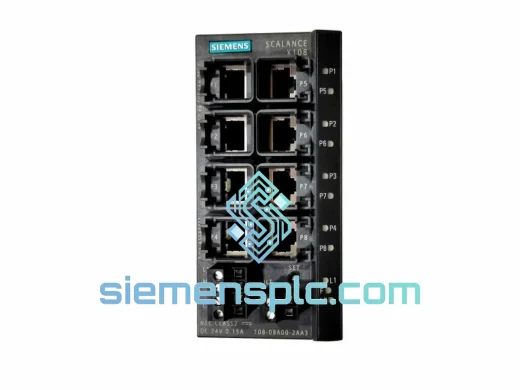
SIEMENS 6GK5108-0BA00-2AA3 Industrial Ethernet Switch
SIMATIC
Origin DE
Industrial Ethernet Switch
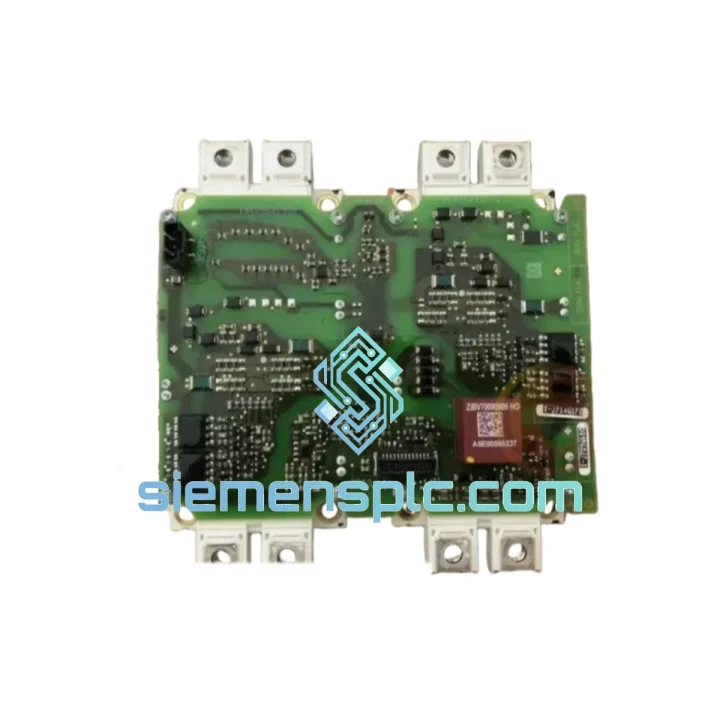
Request verified availability, condition, replacement risk review, packing options and courier lead time for A5E38982303.
Click Request Quote and the part number is inserted into the inquiry form automatically.
Core fields for model confirmation and RFQ routing. Detailed product narrative remains below.
The A5E38982303 is a factory-assembled communication module manufactured by Siemens AG under the SIMATIC S7 product line. Its primary function is to extend the data exchange capacity of an S7 rack by providing a dedicated communication path between the CPU and external field networks or higher-level supervisory systems. Unlike general-purpose interface cards, this module is engineered to operate within the deterministic timing constraints imposed by the S7 backplane bus, making it suitable for applications where scan-cycle jitter directly affects process stability.
In a typical control loop, the CPU executes its program cycle and writes output data to the process image output (PIO) table. The A5E38982303 reads this data from the backplane bus during the I/O update phase and transmits it to the connected network segment. Simultaneously, it receives incoming data from field devices or remote I/O stations and writes it into the process image input (PII) table before the next CPU scan begins. This bidirectional, cycle-synchronous operation ensures that the CPU always works with current field data, which is a non-negotiable requirement in closed-loop control and safety-instrumented systems.
The module’s hardware design reflects Siemens’ approach to industrial-grade reliability: the internal bus interface logic is implemented in application-specific integrated circuits (ASICs) rather than general-purpose microcontrollers, which eliminates firmware-layer latency and reduces the probability of software-induced communication faults. The communication stack is executed in dedicated hardware logic, and the module maintains its own watchdog timer that independently monitors bus activity. If the CPU fails to update the module within the configured monitoring time, the module transitions to a defined safe state — a behavior that is configurable via STEP 7 or TIA Portal and is critical for functional safety applications.
Real-time Stock & RFQ: [email protected] | WhatsApp: +86 18359268345
| Parameter | Value |
|---|---|
| Part Number / SKU | A5E38982303 |
| Manufacturer | Siemens AG |
| Product Family | SIMATIC S7 Communication Module |
| Module Type | Backplane-Coupled Communication Interface |
| Compatible Platform | SIMATIC S7-300 / S7-400 / S7-1500 Rack Systems |
| Bus Interface | S7 Backplane Bus (P-Bus / K-Bus) |
| Communication Protocol | PROFIBUS DP / MPI / Industrial Ethernet (configuration-dependent) |
| Data Transfer Rate | Up to 12 Mbit/s (PROFIBUS DP); up to 100 Mbit/s (IE variant) |
| Operating Voltage | DC 5 V via backplane bus (rack-supplied) |
| Power Consumption | ≤ 2.5 W (typical backplane load) |
| Operating Temperature | 0 °C to +60 °C |
| Storage Temperature | −40 °C to +70 °C |
| Relative Humidity | 10 % to 95 %, non-condensing |
| Protection Class | IP20 (panel-mount, DIN rail rack) |
| Vibration Resistance | 10–58 Hz, 0.075 mm amplitude; 58–150 Hz, 1 g (IEC 60068-2-6) |
| Shock Resistance | 15 g, 11 ms half-sine (IEC 60068-2-27) |
| Weight | Approx. 500 g |
| Dimensions (W × H × D) | Per SIMATIC S7 module form factor |
| Certifications | CE, UL, cUL, RoHS 2011/65/EU |
| Country of Origin | Germany |
| Warranty | 12 months from date of shipment |
| Engineering Tool | STEP 7 V5.x / TIA Portal V15.1 and above |
The A5E38982303 employs a dual-port RAM (DPRAM) architecture at its backplane interface. The CPU and the module’s internal communication processor access this shared memory region through separate address buses, eliminating bus arbitration delays that would otherwise introduce variable latency into the data exchange cycle. The DPRAM is partitioned into input and output data areas, each protected by hardware semaphores that prevent simultaneous write access from both sides — a mechanism that guarantees data consistency without requiring software-level locking routines in the CPU program.
Electromagnetic compatibility (EMC) is addressed at the hardware level through a multi-layer PCB design with dedicated ground planes separating the digital logic layer from the bus interface layer. Transient voltage suppression (TVS) diodes are placed at all external connector pins, and the communication port circuitry is galvanically isolated from the backplane logic via optocouplers rated for a minimum isolation voltage of 500 V DC. This isolation barrier prevents ground loop currents — a common source of communication errors in large industrial installations where multiple cabinets share a common earth reference — from corrupting the signal path.
The module’s internal watchdog operates independently of the CPU’s own watchdog circuit. It monitors the backplane bus token-passing cycle and the communication port’s frame reception rate simultaneously. If either parameter deviates beyond the configured threshold, the watchdog asserts a hardware interrupt to the CPU and simultaneously drives the communication port outputs to a predefined safe state. This dual-watchdog topology means that a failure in the communication network does not go undetected at the CPU level, and the CPU program can execute a controlled shutdown or fallback routine rather than continuing to operate on stale data.
The firmware stored in the module’s flash memory handles protocol-layer functions — frame encoding/decoding, address resolution, and error detection — in a dedicated communication processor. This offloads protocol overhead from the main CPU, which is particularly significant in S7-300 installations where the CPU’s processing bandwidth is shared across multiple rack modules. By handling protocol processing locally, the A5E38982303 ensures that communication tasks do not extend the CPU scan cycle, preserving the determinism of the control loop.
Every A5E38982303 unit supplied by siemensplc.com is sourced exclusively from Siemens AG-authorized distribution channels. Each module carries the original Siemens factory label with date code, batch number, and holographic authenticity marking. Prior to dispatch, units undergo a structured pre-shipment inspection protocol: visual examination of the housing and connector pins for mechanical damage, label verification against the Siemens part number database, and a functional power-on test to confirm that the module initializes correctly and passes its internal self-test routine.
Packaging follows IEC 61340-5-1 electrostatic discharge (ESD) protection requirements. Each module is sealed in a conductive anti-static bag, placed in foam-lined inner packaging, and shipped in a double-wall corrugated outer carton rated for the module’s weight class. This packaging specification is maintained regardless of shipment destination or carrier selection.
Logistics operations are based in Xiamen, China, with direct access to Xiamen Gaoqi International Airport and Xiamen Port, enabling both air freight and sea freight dispatch. Standard air freight transit times are 3–5 business days to major European hubs (Frankfurt, Amsterdam) and 4–6 business days to North American destinations (Los Angeles, Chicago). DHL Express and FedEx International Priority services are available for urgent requirements, with typical door-to-door transit of 2–3 business days to most destinations. Export documentation — including commercial invoice, packing list, certificate of origin, and HS code 8537.10 classification — is prepared in-house and reviewed before each shipment to prevent customs clearance delays.
A 12-month warranty covers all units against manufacturing defects and premature failure under normal operating conditions. Warranty claims are processed within 5 business days of receipt of the returned unit, with replacement dispatch or credit note issued upon confirmation of the defect.
Email: [email protected]
WhatsApp: +86 18359268345
Web: siemensplc.com
Location: Xiamen, China
© 2026 siemensplc.com. All rights reserved.
We check the full part number, brand, series and visible nameplate information before quotation.
Sales confirms stock path, condition option, quantity and realistic lead time for export dispatch.
DHL, FedEx, UPS or buyer courier arrangements can be reviewed with packing requirements.
Similar brand or category products for fast comparison and multi-item RFQ lists.