Siemens
RFQ Ready
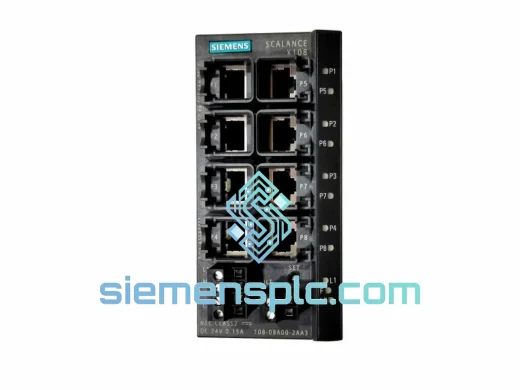
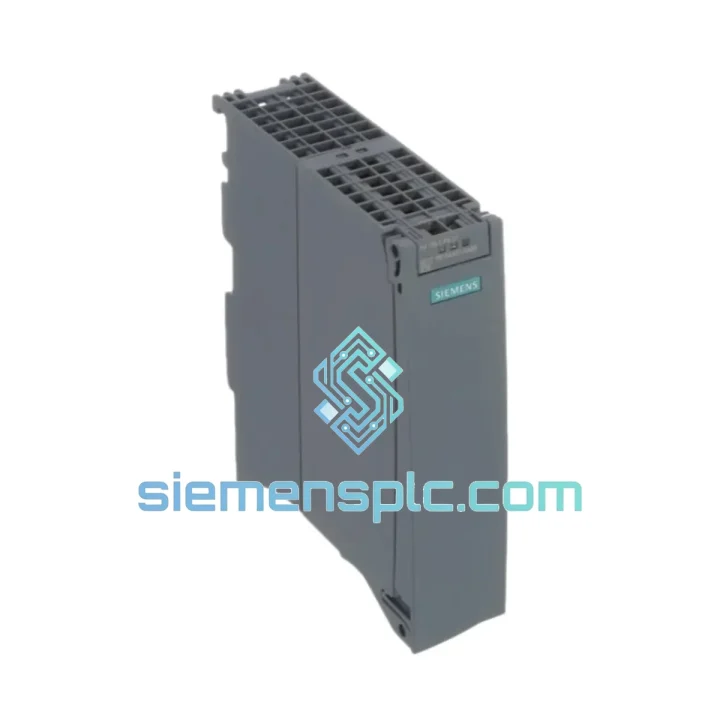
SIEMENS 6GK5108-0BA00-2AA3 Industrial Ethernet Switch
SIMATIC
Origin DE
Industrial Ethernet Switch
Request verified availability, condition, replacement risk review, packing options and courier lead time for 6ES7155-5AA01-0AB0.
Click Request Quote and the part number is inserted into the inquiry form automatically.
Core fields for model confirmation and RFQ routing. Detailed product narrative remains below.
The Siemens 6ES7155-5AA01-0AB0 is the IM 155-5 PN ST (Standard) interface module for the SIMATIC ET 200SP distributed I/O system. It functions as the head station of an ET 200SP assembly, establishing and maintaining the PROFINET IO device connection between a higher-level controller — such as the S7-1500 or S7-1200 — and the downstream I/O module stack. Without this module, the entire ET 200SP station is electrically present but communicatively inert: no process data exchange, no diagnostic reporting, no coordinated actuation. Its role in the control loop is therefore not peripheral — it is the singular arbitration point through which all field-level signals are aggregated, time-stamped, and forwarded to the controller’s process image.
In a typical PROFINET IO topology, the 6ES7155-5AA01-0AB0 operates as an IO-Device. The controller (IO-Controller) cyclically exchanges input and output data with this module across the PROFINET network. The IM 155-5 PN ST manages the internal backplane bus of the ET 200SP station, polling each inserted I/O module at the configured update rate and assembling the consolidated process data image for transmission. The integrated 2-port PROFINET switch allows line topology wiring without external switching hardware, reducing both cabinet footprint and network latency introduced by additional switch hops.
The module supports both RT (Real-Time) and IRT (Isochronous Real-Time) communication classes. In IRT mode, PROFINET traffic is scheduled within reserved bandwidth slots using a synchronized clock domain shared across all IRT-capable devices on the subnet. This eliminates jitter at the microsecond level — a prerequisite for coordinated motion control applications where axis synchronization tolerances are measured in encoder counts, not milliseconds. The 6ES7155-5AA01-0AB0 achieves IRT cycle times as low as 250 µs, making it suitable for high-speed servo coordination tasks when paired with IRT-capable controllers and switches.
The Shared Device feature allows up to two independent PROFINET IO-Controllers to access subsets of the ET 200SP station’s I/O modules simultaneously. This is architecturally significant in safety-integrated systems where a standard S7-1500 controller manages process I/O while a separate F-CPU handles safety-relevant signals on the same physical station — eliminating the need for a second ET 200SP assembly and its associated wiring infrastructure.
PROFIenergy support enables the controller to issue standardized energy-saving commands to the station during planned production pauses. The IM 155-5 PN ST relays these commands to compatible I/O modules, which can reduce power draw on actuator supply circuits. This is particularly relevant in automotive body shop applications where robot cells enter idle states between vehicle body transfers.
Real-time stock inquiry and RFQ: [email protected] | WhatsApp: +86 18359268345
| Parameter | Value |
|---|---|
| Part Number (MLFB) | 6ES7155-5AA01-0AB0 |
| Product Family | SIMATIC ET 200SP |
| Module Designation | IM 155-5 PN ST (Standard) |
| Communication Protocol | PROFINET IO (IO-Device) |
| PROFINET Ports | 2 × RJ45, integrated 2-port switch |
| Real-Time Classes | RT, IRT (Isochronous Real-Time) |
| Minimum IRT Cycle Time | 250 µs |
| Max. I/O Modules per Station | 32 (incl. technology and CM modules) |
| Supply Voltage | 24 V DC (20.4 V – 28.8 V) |
| Current Consumption (24 V DC) | ≤ 100 mA (module internal logic) |
| Backplane Bus Current Output | Max. 2 A (for I/O module supply) |
| PROFINET Conformance Class | Class B |
| MRP Support | Yes — MRP Client (ring redundancy) |
| Shared Device | Yes — up to 2 IO-Controllers |
| PROFIenergy | Supported |
| Degree of Protection | IP20 |
| Operating Temperature | 0 °C to +60 °C |
| Storage Temperature | −40 °C to +70 °C |
| Relative Humidity | 5% to 95% (non-condensing) |
| Mounting | 35 mm DIN rail (EN 60715) |
| Dimensions (W × H × D) | 70 × 117 × 74 mm |
| Weight | Approx. 320 g |
| Configuration Tool | TIA Portal V13 SP1 and above |
| Firmware Update | Via PROFINET / TIA Portal online |
| CE / UL / cULus | Certified |
| Warranty | 12 months from shipment date |
Backplane Bus Architecture: The ET 200SP backplane bus is a proprietary high-speed serial bus embedded in the BaseUnit rail. The IM 155-5 PN ST acts as the bus master, issuing cyclic read/write commands to each I/O module’s local bus interface controller (LBIC). Each I/O module’s LBIC buffers process data and responds within a deterministic window. The bus arbitration logic in the 6ES7155-5AA01-0AB0 ensures that all 32 module slots are polled within a single PROFINET cycle, with the aggregated data assembled into the IO-Device’s input/output data record before PROFINET frame transmission. This architecture eliminates the polling jitter that would occur if each module were individually addressable over the network.
EMC Design: The module housing integrates a grounded metal shield frame that provides continuous shielding continuity across the DIN rail mounting point. The PROFINET RJ45 ports incorporate common-mode chokes and transient voltage suppression (TVS) diodes rated for IEC 61000-4-5 surge immunity at ±2 kV (line-to-earth). The internal power supply section uses a DC-DC converter with galvanic isolation between the 24 V DC input and the internal 3.3 V logic rail, providing a minimum isolation voltage of 500 V DC. This isolation prevents ground loop currents — common in large industrial panels with multiple earthing points — from coupling noise into the module’s logic circuitry.
Diagnostic Transparency: The 6ES7155-5AA01-0AB0 implements the PROFINET Alarm mechanism at the IO-Device level. When a downstream I/O module detects a channel fault (e.g., wire break on a digital input, overrange on an analog channel), the IM 155-5 PN ST generates a Process Alarm and transmits it to the IO-Controller within the next PROFINET cycle — independent of the cyclic data exchange. The controller’s OB 82 (diagnostic interrupt OB) is triggered, allowing the application program to respond to field faults without polling. This event-driven diagnostic model reduces controller scan load compared to software-based polling routines.
IRT Clock Synchronization: In IRT mode, the module synchronizes its internal transmission clock to the PROFINET sync master (typically the IO-Controller or a dedicated sync master switch) using the IEEE 1588-derived PTCP (Precision Transparent Clock Protocol). Clock deviation is maintained below ±1 µs across the synchronized domain. The IM 155-5 PN ST’s IRT scheduler reserves a fixed bandwidth slot in each PROFINET cycle for IRT traffic, ensuring that cyclic process data is transmitted at a jitter-free interval regardless of acyclic traffic load (e.g., parameter writes, firmware updates) on the same network segment.
Every Siemens 6ES7155-5AA01-0AB0 unit supplied by siemensplc.com is sourced as genuine Siemens factory-produced hardware. Authenticity is verified through cross-referencing the module’s factory serial number and date code against Siemens production records, combined with physical inspection of the holographic security label, MLFB laser marking, and connector pin condition. Modules showing any evidence of remarking, repackaging, or non-original firmware are rejected at intake.
Our warehouse is located in Xiamen, China — a major export hub with direct access to international express carriers including DHL Express, FedEx International Priority, and UPS Worldwide Expedited. Standard export documentation (commercial invoice, packing list, certificate of origin) is prepared for each shipment. For orders requiring customs pre-clearance documentation or specific HS code declarations (HS 8537.10 for programmable controllers and associated modules), our logistics team coordinates with freight forwarders to ensure compliant clearance at destination ports across Europe, Southeast Asia, the Americas, and the Middle East.
Typical dispatch lead time from order confirmation is 1–3 business days for in-stock units. Express air freight transit times are 3–7 business days to most destinations. All shipments include full tracking and are covered by cargo insurance. A 12-month warranty applies from the shipment date, covering verified manufacturing defects. Warranty claims are processed with replacement dispatch or credit note within 5 business days of fault confirmation.
Email: [email protected]
WhatsApp: +86 18359268345
Web: siemensplc.com
Location: Xiamen, China
© 2026 siemensplc.com. All rights reserved.
We check the full part number, brand, series and visible nameplate information before quotation.
Sales confirms stock path, condition option, quantity and realistic lead time for export dispatch.
DHL, FedEx, UPS or buyer courier arrangements can be reviewed with packing requirements.
Similar brand or category products for fast comparison and multi-item RFQ lists.