Mitsubishi Electric
RFQ Ready
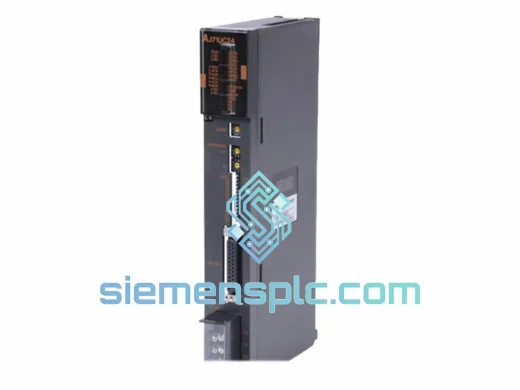
MITSUBISHI AX81 PLC Communication Module
MELSEC-A
Origin JP
PLC Communication Module
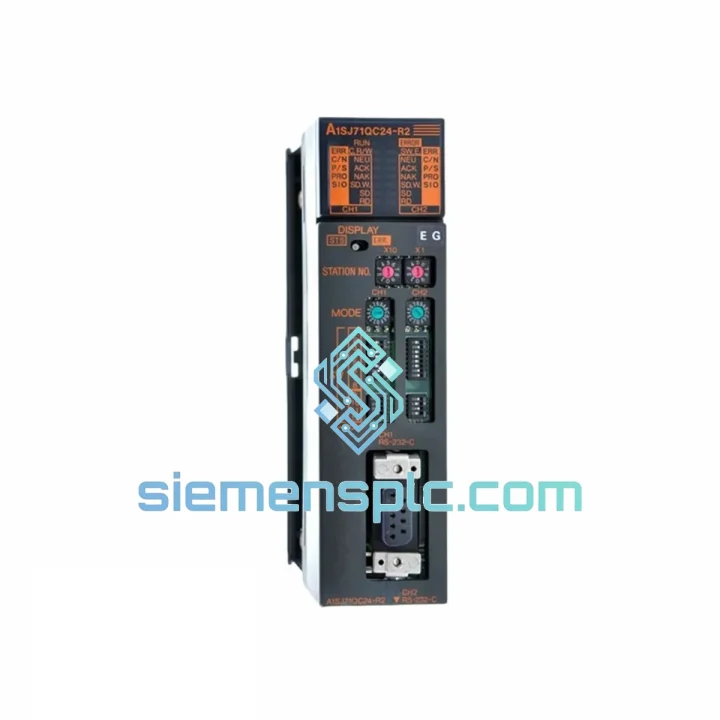
Request verified availability, condition, replacement risk review, packing options and courier lead time for A1SJ71QC24-R2.
Click Request Quote and the part number is inserted into the inquiry form automatically.
Core fields for model confirmation and RFQ routing. Detailed product narrative remains below.
The A1SJ71QC24-R2 occupies a structurally critical position within the MELSEC-A compact PLC platform. Its function is not supplementary — it is the sole hardware interface through which the A1S/A2S CPU exchanges serial data with external devices: HMIs, SCADA hosts, barcode readers, variable-frequency drives, and third-party controllers. Without this module, the CPU operates as a closed-loop processor with no upstream or downstream data visibility. In maintenance-intensive environments — automotive body shops, semiconductor fabs, water treatment stations — that isolation translates directly into unplanned downtime and diagnostic opacity.
The module implements RS-422 full-duplex differential signaling on its R2 port variant. RS-422 supports multi-drop topologies at cable runs up to 1,200 m, with a maximum data rate of 19,200 bps under the QC24 protocol frame. The differential pair architecture provides inherent common-mode noise rejection, making the A1SJ71QC24-R2 suitable for deployment in high-EMI environments where single-ended RS-232C links would be unreliable. The module occupies one slot on the A1S38B, A1S52B, A1S55B, or A1S58B base unit and draws its operating power from the backplane bus — no external power supply is required.
Communication is governed by Mitsubishi’s QC24 protocol, which is a subset of the broader MC Protocol (MELSEC Communication Protocol) framework. The QC24 frame structure supports both ASCII and binary transmission modes. ASCII mode simplifies debugging with standard serial monitors; binary mode reduces frame overhead by approximately 50%, increasing effective throughput for high-frequency polling applications. The module’s internal buffer handles asynchronous data exchange between the serial port and the CPU’s shared memory area, decoupling the communication cycle from the CPU scan cycle and preventing scan-time jitter caused by serial I/O wait states.
The A1SJ71QC24-R2 is compatible with A1SCPU, A1SHCPU, A2SCPU, and A2SHCPU processor modules. It is programmed via GX Developer or GX Works2 (with A-series support enabled), using the FROM/TO instruction set to access the module’s buffer memory registers. No dedicated communication ladder blocks are required — the module operates autonomously once initialized, with the CPU reading status and data registers on demand. This architecture minimizes CPU processing overhead and keeps the scan cycle deterministic regardless of serial communication load.
Real-time Stock & RFQ: [email protected] | WhatsApp: +86 18359268345
| Parameter | Specification |
|---|---|
| Part Number | A1SJ71QC24-R2 |
| Manufacturer | Mitsubishi Electric Corporation |
| Series | MELSEC-A (A1S Compact) |
| Module Category | Serial Communications Module |
| Communication Interface | RS-422 (R2 variant) |
| Transmission Mode | Full-duplex differential |
| Protocol | QC24 / MC Protocol (ASCII & Binary) |
| Max Baud Rate | 19,200 bps |
| Max Cable Length | 1,200 m (RS-422 multi-drop) |
| Applicable CPUs | A1SCPU, A1SHCPU, A2SCPU, A2SHCPU |
| Compatible Base Units | A1S38B, A1S52B, A1S55B, A1S58B |
| Slot Occupation | 1 slot |
| Power Consumption | Backplane bus powered (5 VDC) |
| Operating Temperature | 0 °C to +55 °C |
| Storage Temperature | -20 °C to +75 °C |
| Relative Humidity | 5% to 95% RH (non-condensing) |
| Weight | 420 g |
| Country of Origin | Japan |
| Warranty | 12 months from date of shipment |
The A1SJ71QC24-R2 implements a dual-port memory architecture that separates the serial communication engine from the CPU’s program execution environment. The module contains an internal 8-bit microprocessor dedicated to managing the UART state machine, frame assembly, checksum verification, and buffer management. This dedicated processor handles all QC24 protocol overhead — start/end code detection, station number filtering, command parsing — without consuming any of the A1SCPU’s processing bandwidth.
The RS-422 physical layer uses balanced differential signaling with a nominal differential voltage of ±2 V to ±6 V. The receiver threshold is ±200 mV, providing a 10:1 noise margin over the minimum signal level. This margin is significant in industrial panel environments where 400 V AC motor drives, contactors, and switching power supplies generate conducted and radiated EMI in the 150 kHz to 30 MHz range. The differential pair rejects common-mode interference up to ±7 V, which covers the majority of ground potential differences encountered in multi-cabinet installations.
The module’s buffer memory is organized as a 16-bit word-addressable register file. Transmission data registers (BFM #0 to #511) and reception data registers (BFM #512 to #1023) are independently accessible via FROM/TO instructions. The separation of transmit and receive buffers eliminates read-modify-write contention and allows the CPU to pre-load the next transmission frame while the current frame is still being clocked out — a pipelining behavior that improves effective throughput at higher baud rates.
The terminal block connector on the R2 variant uses a screw-clamp design rated for wire gauges from 0.3 mm² to 1.5 mm² (AWG 22 to AWG 16). The screw torque specification of 0.5 N·m ensures consistent contact resistance over the module’s service life, even under vibration conditions up to 10 Hz–57 Hz at 0.075 mm amplitude per IEC 60068-2-6. The connector’s IP20 finger-safe rating prevents accidental contact with live terminals during maintenance operations.
Every A1SJ71QC24-R2 unit supplied by siemensplc.com is sourced through verified Mitsubishi Electric authorized distribution channels. Each unit undergoes a four-stage inspection protocol before shipment:
Shipments originate from Xiamen, China (Xiamen Gaoqi International Airport, XMN / Xiamen Port). Standard export documentation includes commercial invoice, packing list, and certificate of origin. DHL Express and FedEx International Priority are the primary carriers, with typical transit times of 3–5 business days to Europe, 4–6 business days to North America, and 2–3 business days to Southeast Asia. Expedited same-day dispatch is available for orders confirmed before 14:00 CST. All shipments include full tracking and are covered by the 12-month warranty from the date of delivery confirmation.
Email: [email protected]
WhatsApp: +86 18359268345
Web: siemensplc.com
Location: Xiamen, China
© 2026 siemensplc.com. All rights reserved.
We check the full part number, brand, series and visible nameplate information before quotation.
Sales confirms stock path, condition option, quantity and realistic lead time for export dispatch.
DHL, FedEx, UPS or buyer courier arrangements can be reviewed with packing requirements.
Similar brand or category products for fast comparison and multi-item RFQ lists.