Allen-Bradley
RFQ Ready
Allen-Bradley 1756-L81E ControlLogix Controller
ControlLogix
Origin US
PLC Controller
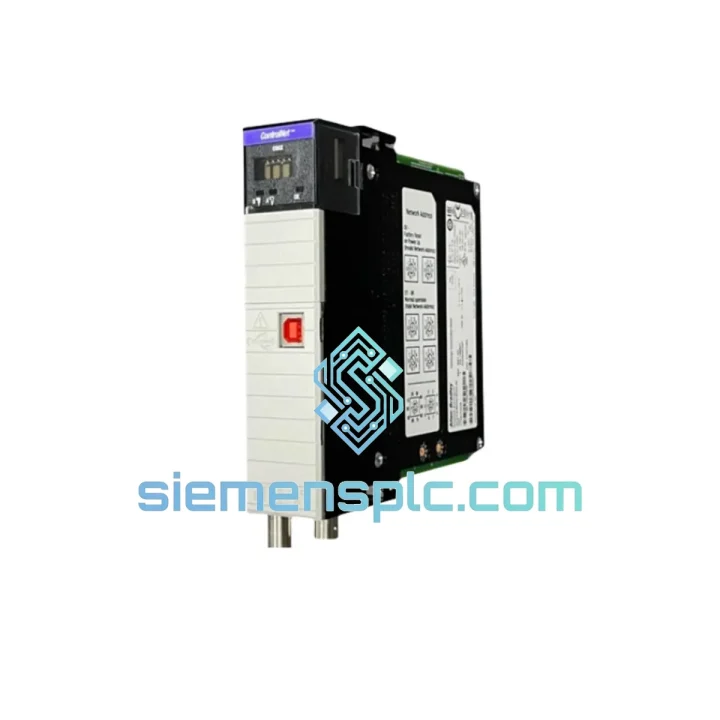
Request verified availability, condition, replacement risk review, packing options and courier lead time for 1756-CN2/C.
Click Request Quote and the part number is inserted into the inquiry form automatically.
Core fields for model confirmation and RFQ routing. Detailed product narrative remains below.
The 1756-CN2/C is a single-slot ControlNet communication bridge module designed for the Allen-Bradley ControlLogix 1756 chassis platform. Its architectural role is precise: it terminates a ControlNet coaxial segment at the physical and data-link layers, then presents scheduled and unscheduled connection objects to the ControlLogix backplane via the proprietary 200 Mbps high-speed serial bus. The result is a hard-bounded data path between field-level I/O adapters, remote chassis, and the host controller — a path whose worst-case latency is mathematically defined by the configured Network Update Time (NUT) rather than by probabilistic collision avoidance.
The /C hardware revision reflects a third-generation ASIC spin that tightened NUT synchronization tolerance and extended the module’s thermal operating ceiling. In practice, this means the 1756-CN2/C can sustain a 2 ms NUT across a 99-node segment without accumulating phase drift that would otherwise force the network scheduler to widen guard bands — a failure mode observed in earlier /A and /B revisions under sustained high-node-count loads. The module draws 1.0 A from the 5 VDC backplane rail, compatible with the 1756-PA72 and 1756-PB72 power supplies across all standard chassis densities (4-, 7-, 10-, 13-, and 17-slot).
In distributed control architectures, the 1756-CN2/C functions as the synchronization master or keeper for its ControlNet segment. The keeper role — responsible for storing the scheduled connection map and broadcasting it to all nodes at power-up — is assigned per segment and can be held by the CN2/C module, eliminating the need for a dedicated keeper device in single-controller topologies. This reduces BOM complexity in greenfield installations and simplifies segment recovery after a power cycle.
Real-time Stock & RFQ: [email protected] | WhatsApp: +86 18359268345
| Parameter | Specification |
|---|---|
| Manufacturer | Allen-Bradley / Rockwell Automation |
| Catalog Number | 1756-CN2/C |
| Platform | ControlLogix 1756 |
| Module Function | ControlNet Communication Bridge (Keeper-capable) |
| Network Standard | ControlNet IEC 61158 / EN 50170, 5 Mbps fixed |
| Chassis Slots | 1 slot (any 1756-series chassis) |
| Backplane Current (5 VDC) | 1.0 A |
| Power Dissipation | 5.0 W maximum |
| ControlNet Node Address | 1 – 99 (software configurable) |
| Scheduled Connections (max) | 64 per module |
| Unscheduled Connections (max) | 32 concurrent |
| Network Update Time (NUT) | 2 ms – 100 ms, configurable in RSNetWorx for ControlNet |
| NUT Synchronization Jitter (/C rev) | < ±1 ms at full 99-node load |
| Physical Connectors | 2 × BNC (coaxial), daisy-chain topology |
| Media Redundancy | Hardware-level automatic failover, < 1 NUT cycle switchover |
| Backplane Bus Speed | 200 Mbps (ControlLogix proprietary serial) |
| Backplane Error Detection | Hardware CRC per packet, automatic retransmit on single-bit error |
| Operating Temperature | 0 °C to +60 °C |
| Storage Temperature | -40 °C to +85 °C |
| Relative Humidity | 5% – 95% non-condensing |
| Vibration (IEC 68-2-6) | 2 g, 10 – 500 Hz |
| Shock (IEC 68-2-27) | 30 g, 11 ms half-sine |
| ESD Immunity | IEC 61000-4-2, Level 3 |
| EFT/Burst Immunity | IEC 61000-4-4, Level 3 |
| Surge Immunity (BNC ports) | IEC 61000-4-5, ±1.5 kV TVS protection |
| Certifications | UL 508, CE (EMC Dir. 2014/30/EU, LVD Dir. 2014/35/EU), cUL, RoHS |
| Firmware Update Method | ControlFlash over backplane (no physical removal required) |
| Hot-Swap Support | Yes — chassis insertion/removal under power |
| Approximate Weight | 100 g |
| Warranty | 12 months from date of shipment |
The 1756-CN2/C employs a dual-port shared memory architecture that physically separates the ControlNet media access controller (MAC) from the ControlLogix backplane interface logic. An embedded RISC processor — dedicated solely to ControlNet TDMA scheduling — manages the segment’s time-slot allocation table independently of the host controller’s scan cycle. This processor maintains the NUT clock reference and arbitrates bandwidth allocation between scheduled and unscheduled traffic windows without any software intervention from the ControlLogix CPU. The practical consequence is that controller task overload — a condition where the L6x or L7x CPU is executing compute-intensive function block routines — does not propagate jitter into the ControlNet NUT cycle. The two subsystems share data through a dual-port RAM block with hardware semaphore arbitration, ensuring atomic read/write access without bus contention.
The physical layer front-end uses two BNC ports wired in a standard ControlNet daisy-chain configuration. In redundant media mode, both coaxial paths carry identical scheduled data simultaneously. The onboard media redundancy logic continuously compares signal quality metrics on both paths using a hardware comparator circuit. When the primary path signal-to-noise ratio drops below threshold — due to cable damage, connector corrosion, or external RF interference — the comparator asserts a failover signal that switches the active receive path within the current NUT cycle. This switchover is entirely implemented in programmable logic (CPLD), not in firmware, which eliminates the interrupt latency and context-switch overhead that would be present in a software-managed failover routine.
EMC hardening follows a layered strategy. The PCB uses a six-layer stackup with dedicated ground planes between signal layers, reducing inter-layer crosstalk below the noise floor of the ControlNet receiver. The analog BNC front-end is physically isolated from the digital backplane section by a ground moat routed around the receiver IC, preventing high-frequency switching noise from the backplane bus from coupling into the coaxial signal path. TVS diode arrays at each BNC port clamp transient voltages to ±1.5 kV per IEC 61000-4-5 Level 3, protecting the receiver IC from surge events induced by nearby VFD switching or lightning-coupled transients on long cable runs. The die-cast aluminum housing provides a continuous Faraday enclosure; conductive elastomer gaskets at the front-panel and backplane connector interfaces maintain shield continuity across the full operating temperature range, preventing gasket-induced shield gaps that would otherwise create radiated emission hot spots.
Backplane communication uses hardware CRC-16 checking on every packet exchanged between the CN2/C and the ControlLogix backplane arbiter. A single-bit error detected by the CRC engine triggers an immediate hardware retransmit request — the corrupted packet is discarded before it reaches the module’s dual-port RAM, preventing data corruption from propagating to the ControlNet scheduled output table. This fault containment boundary is particularly relevant in multi-module chassis configurations where a backplane noise event could otherwise affect multiple communication modules simultaneously.
Each 1756-CN2/C unit dispatched from siemensplc.com undergoes a structured pre-shipment verification protocol. Physical inspection confirms label integrity, catalog number, and hardware revision marking against OEM reference documentation. The module is powered in a live 1756 chassis to verify backplane enumeration and ControlNet node address assignment. Firmware version is logged against the current Rockwell Automation release matrix, and the module’s ControlNet MAC address is recorded in the shipment documentation for traceability. Units that fail any verification step are quarantined; they are not relisted or shipped.
Logistics operations are based in Xiamen, China, with bonded warehouse access that accelerates customs clearance for international shipments. Standard export documentation — commercial invoice, packing list, certificate of origin, and HS code declaration (HS 8537.10) — is prepared for every order. Courier options include DHL Express (2–4 business days to most destinations), FedEx International Priority, and UPS Worldwide Expedited. For orders of 5 or more units, consolidated air freight is available with door-to-door tracking. Sea freight (LCL or FCL) is available for bulk procurement orders. All units are packed in anti-static foam-lined cartons with humidity indicator cards; packaging meets ISTA 2A transit testing standards.
A 12-month warranty from the date of shipment covers manufacturing defects and functional failures under normal operating conditions as defined in the 1756-CN2/C installation instructions (publication 1756-IN576). Post-delivery technical support covers RSNetWorx for ControlNet configuration, keeper assignment, NUT optimization, and compatibility verification with existing ControlLogix system revisions and firmware levels.
Email: [email protected]
WhatsApp: +86 18359268345
Web: siemensplc.com
Location: Xiamen, China
© 2026 siemensplc.com. All rights reserved.
We check the full part number, brand, series and visible nameplate information before quotation.
Sales confirms stock path, condition option, quantity and realistic lead time for export dispatch.
DHL, FedEx, UPS or buyer courier arrangements can be reviewed with packing requirements.
Similar brand or category products for fast comparison and multi-item RFQ lists.