
DALSA
In Stock OK
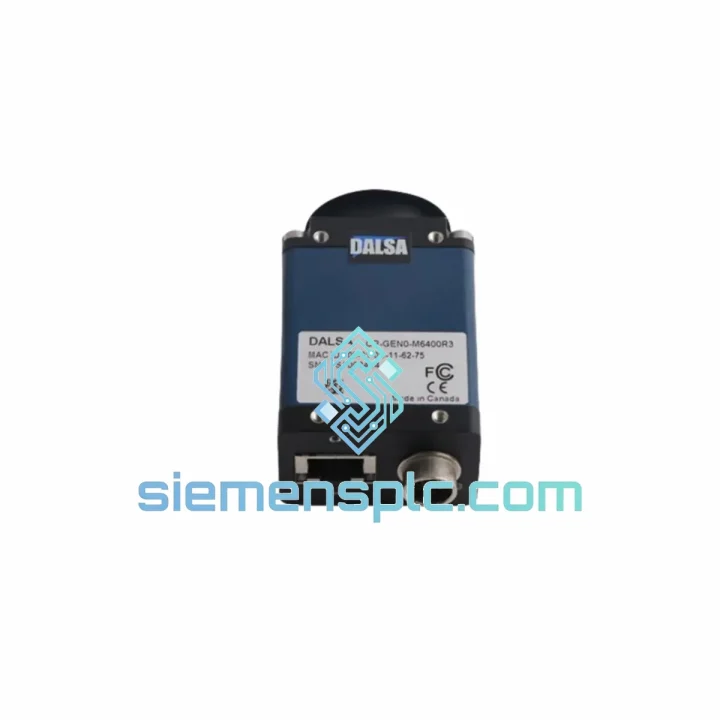
DALSA CR-GEN0-M6400R3 Machine Vision Camera – Genie Series
Request verified availability, condition, replacement risk review, packing options and courier lead time for CR-GEN0-M6400R3.
BrandDALSA
Part NumberCR-GEN0-M6400R3
ConditionAvailability Check
Lead TimeRFQ Confirmation
DocumentsDatasheet / photos by RFQ
ShippingExport packing available
Auto-filled RFQ
CR-GEN0-M6400R3
Click Request Quote and the part number is inserted into the inquiry form automatically.
- Reply by email: [email protected]
- WhatsApp / Tel: +86 18359268345
- Mon-Sat 9:00-18:00 GMT+8
Procurement Data
Key Product Information
Core fields for model confirmation and RFQ routing. Detailed product narrative remains below.
- Brand
- DALSA
- Primary Part Number
- CR-GEN0-M6400R3
- Product Type
- Machine Vision Camera
- Series / Family
- 6.4 MP Area Scan
- Country of Origin
- Not specified
- Catalog Category
- Industrial Automation Spares
- Operating Temp.
- 0 °C to +50 °C (non-condensing)
- Warranty
- 12 months from date of shipment
- Compliance
- GigE Vision 1.2, GenICam 2.x, CE, FCC, RoHS
Model confirmed for inquiry
CR-GEN0-M6400R3
Send quantity, destination and urgency. The RFQ form keeps this part number attached.
Request Quote
Product Overview
DALSA CR-GEN0-M6400R3 — 6.4 MP Monochrome Area Scan Camera for Precision Machine Vision Architectures
The CR-GEN0-M6400R3 is a 6.4-megapixel monochrome area scan camera from Teledyne DALSA’s Genie Nano series, engineered for deployment in deterministic machine vision systems where spatial resolution, signal fidelity, and transport-layer reliability are primary design constraints. The device operates over a GigE Vision-compliant 1000BASE-T Ethernet interface, enabling integration into standard plant network infrastructure without proprietary frame grabbers or dedicated coaxial cabling. At 6.4 MP, the sensor resolves fine surface features — sub-millimeter defects, character verification on component markings, dimensional gauging at tight tolerances — across a wide field of view, reducing the number of camera stations required per inspection zone and lowering total system cost.
The monochrome sensor architecture is a deliberate engineering choice for industrial inspection. Without the Bayer color filter array, every photosite contributes directly to luminance measurement, yielding a quantum efficiency curve that peaks in the 500–600 nm range and extends usably into the near-infrared (700–900 nm). This spectral range is exploited in structured-light and laser-line triangulation setups where NIR illumination penetrates surface coatings to reveal subsurface geometry. In contrast to color sensors of equivalent resolution, the CR-GEN0-M6400R3 delivers higher SNR per pixel at equivalent illumination levels — a measurable advantage in high-speed applications where exposure time is constrained by conveyor velocity.
Within a closed-loop quality control circuit, the camera occupies the image acquisition node between the illumination controller and the vision processing host. Its hardware trigger input — opto-isolated, accepting 5–24 VDC — synchronizes frame capture to an encoder pulse or PLC output with sub-microsecond jitter, ensuring that each acquired frame corresponds to a precisely defined product position. The GenICam-compliant register map exposes all acquisition parameters — exposure time, analog gain, black level offset, trigger delay, and ROI geometry — through a standardized XML device description, eliminating vendor-specific API dependencies and simplifying migration between software platforms.
Real-time Stock & RFQ: [email protected] | WhatsApp: +86 18359268345
Technical Parameters
| Parameter | Specification |
|---|---|
| Part Number | CR-GEN0-M6400R3 |
| Brand | Teledyne DALSA |
| Series | Genie Nano |
| Sensor Format | Monochrome Area Scan |
| Resolution | 6.4 MP (3208 × 2200 px, nominal) |
| Interface | GigE Vision 1.2 / 1000BASE-T Ethernet |
| Pixel Format | Mono8, Mono10, Mono12 (GenICam standard) |
| Trigger Input | Opto-isolated, 5–24 VDC, hardware & software trigger |
| Digital I/O | Configurable input/output lines for strobe and encoder sync |
| Power Input | Power over Ethernet (IEEE 802.3af PoE) or auxiliary DC |
| Lens Mount | C-mount |
| Operating Temperature | 0 °C to +50 °C (non-condensing) |
| Storage Temperature | −20 °C to +70 °C |
| Compliance | GigE Vision 1.2, GenICam 2.x, CE, FCC, RoHS |
| SDK Compatibility | Teledyne DALSA Sapera LT; any GigE Vision-compliant SDK |
| Origin | Canada (Teledyne DALSA, Waterloo, Ontario) |
| Warranty | 12 months from date of shipment |
Hardware Logical Analysis
GVSP Transport Layer and Packet Resend Architecture: Image data is encapsulated in UDP/IP datagrams using the GigE Vision Streaming Protocol (GVSP). Each data block carries a sequence number; the receiving host detects gaps and issues GVSP RESEND requests for missing packets within a configurable resend timeout window. This selective-resend mechanism recovers from transient Ethernet collisions without requiring a full frame retransmission, sustaining effective throughput on managed switches with QoS-prioritized GVSP traffic. On a dedicated, isolated Gigabit segment, the CR-GEN0-M6400R3 sustains continuous streaming at full 6.4 MP resolution without frame loss — a prerequisite for 100% inline inspection at production line speeds.
Opto-Isolated Trigger Path and Jitter Budget: The hardware trigger input uses a phototransistor-based opto-coupler between the external signal line and the internal FPGA trigger logic. Galvanic isolation breaks the ground reference between the camera and the triggering device — typically a Siemens S7-series digital output, a proximity sensor, or an encoder index pulse — preventing common-mode noise from variable-frequency drives and servo amplifiers from coupling into the timing circuit. The resulting trigger-to-exposure-start latency is deterministic within a sub-microsecond window, enabling strobe pulse width to be calculated from conveyor velocity and exposure time without empirical tuning. For applications running at 1,000 mm/s conveyor speed with a 200 µs exposure, this jitter budget translates to less than 0.2 µm of positional uncertainty per pixel — well within the tolerance band of most dimensional gauging tasks.
FPGA-Based Pixel Processing Pipeline: An on-board FPGA handles analog-to-digital conversion management, black level subtraction, and pixel data formatting before packetization. The FPGA pipeline operates at sensor clock frequency, ensuring that pixel data is formatted and queued for Ethernet transmission without introducing frame-to-frame latency variation. Configurable lookup tables (LUTs) within the FPGA allow gamma correction and custom tone mapping to be applied in hardware, offloading this computation from the host CPU and maintaining consistent image characteristics across varying illumination conditions without software-side preprocessing overhead.
ROI Windowing and Bandwidth Reduction: The camera supports arbitrary rectangular ROI definition through GenICam OffsetX, OffsetY, Width, and Height registers. Reducing the active ROI to the inspection zone — for example, a 1600 × 400 px strip across a label verification area — proportionally reduces the pixel data volume transmitted per frame. At a 4× ROI reduction, the effective frame rate increases by approximately the same factor on a bandwidth-limited link, enabling higher throughput without upgrading network infrastructure. This is particularly relevant in multi-camera architectures where several CR-GEN0-M6400R3 units share a managed switch uplink.
System Integration Benefits
- Direct PLC I/O Compatibility: The opto-isolated trigger input accepts signal levels from Siemens S7-1200, S7-1500, S7-300, Allen-Bradley ControlLogix, Mitsubishi MELSEC, and Omron NX/NJ series digital outputs without intermediate relay or signal converter hardware, reducing BOM complexity and panel wiring labor.
- Standard Network Infrastructure Reuse: Operates on existing plant Gigabit Ethernet switches with VLAN segmentation and DSCP-based QoS for GVSP traffic — no proprietary frame grabber PCIe slots, no Camera Link cables, no dedicated coaxial infrastructure required.
- Multi-Camera Host Consolidation: Multiple CR-GEN0-M6400R3 units connect to a single industrial PC via a managed switch, each assigned a unique IP address and GVSP destination port. A quad-core host with a standard Gigabit NIC can sustain simultaneous acquisition from four cameras at reduced ROI, enabling multi-station inspection from a single processing node.
- Strobe Controller Synchronization: The programmable output line generates a flash trigger derived from the internal exposure timing signal, driving Gardasoft, CCS, and Metaphase strobe controllers with microsecond-accurate pulse timing. Illumination is active only during sensor integration, eliminating motion blur artifacts on conveyors running above 500 mm/s.
- Third-Party Vision Software Interoperability: GenICam compliance ensures validated operation with MVTec HALCON, Cognex VisionPro, National Instruments Vision Builder, and OpenCV via open-source GigE Vision SDK wrappers — no camera-specific acquisition code required in the application layer.
- Remote Parameter Management: All acquisition parameters are accessible over the network via GigE Vision Control Protocol (GVCP), enabling remote adjustment of exposure, gain, trigger delay, and ROI without physical access to the camera — essential for units mounted inside enclosures, on robotic arms, or in Class 1 Div 2 areas where access is restricted.
- Encoder-Based Trigger Integration: The trigger input can be driven directly from a quadrature encoder’s index channel through a simple voltage divider or line driver, enabling position-based image acquisition synchronized to product registration marks rather than fixed time intervals — eliminating positional error accumulation over long conveyor runs.
- Scalable Bandwidth Architecture: ROI windowing, pixel format selection (Mono8 vs. Mono12), and packet size configuration (jumbo frames up to 9000 bytes on supported switches) provide three independent levers for bandwidth optimization, allowing the system integrator to tune throughput versus image depth trade-offs without hardware changes.
Quality Assurance & Global Logistics
Each CR-GEN0-M6400R3 unit supplied through siemensplc.com is sourced from verified original-equipment distribution channels. Upon receipt at our Xiamen facility, units undergo a structured incoming inspection protocol: C-mount thread gauge check, Ethernet connector contact integrity verification, housing seam and label authentication against manufacturer reference samples, and a powered GigE link establishment test confirming GVCP handshake and basic image acquisition at default parameters. Units that do not pass all inspection checkpoints are quarantined and returned to the supply chain — they are not offered for sale.
Packaging is prepared to IEC 60068-2-27 shock and IEC 60068-2-64 vibration transport standards: ESD-safe inner wrap, closed-cell polyethylene foam inserts contoured to the camera body, and a double-wall outer carton rated for the unit’s weight class. Humidity indicator cards are included in all ocean freight consignments. Export documentation — commercial invoice, packing list, certificate of origin, HS code 8525.89 declaration, and ECCN classification where applicable — is prepared as standard for all international shipments.
Dispatch is from Xiamen, China, with access to DHL Express, FedEx International Priority, and UPS Worldwide Express. Indicative transit times: Southeast Asia 2–3 business days; Europe 3–5 business days; North America 4–5 business days; Middle East and Africa 4–7 business days. All consignments include end-to-end tracking and carrier liability coverage. Same-day dispatch is available for orders confirmed before 14:00 CST on business days, subject to stock availability confirmed at time of order.
The 12-month warranty covers manufacturing defects and functional failures under the operating conditions specified in the manufacturer’s datasheet. Warranty claims are acknowledged within 1 business day. Where replacement stock is available in Xiamen, a replacement unit is dispatched before the defective unit is returned, minimizing production line downtime for time-critical customers.
Contact Information
Email: [email protected]
WhatsApp: +86 18359268345
Web: siemensplc.com
Location: Xiamen, China
© 2026 siemensplc.com. All rights reserved.
Ready to quote
[email protected]
Send This Part Number to Sales
RFQ workflow
Quality workflow ->
Confirmation Process
01Model confirmation
We check the full part number, brand, series and visible nameplate information before quotation.
02Availability reply
Sales confirms stock path, condition option, quantity and realistic lead time for export dispatch.
03Packing & courier
DHL, FedEx, UPS or buyer courier arrangements can be reviewed with packing requirements.
Continue sourcing
Browse full catalog ->
Related Automation Parts
Similar brand or category products for fast comparison and multi-item RFQ lists.
ABB
RFQ Ready
ABB 3HAC9330-1 Robot Speed Reducer – IRB6640-205/2.7
lRB240046 RB460
Origin SE
Robot Speed Reducer
ABB
RFQ Ready
ABB YPP109A YPN106A EG2401S-AR DCS Power Module
Symphony Plus
Origin SE
DCS Power Module